Overview
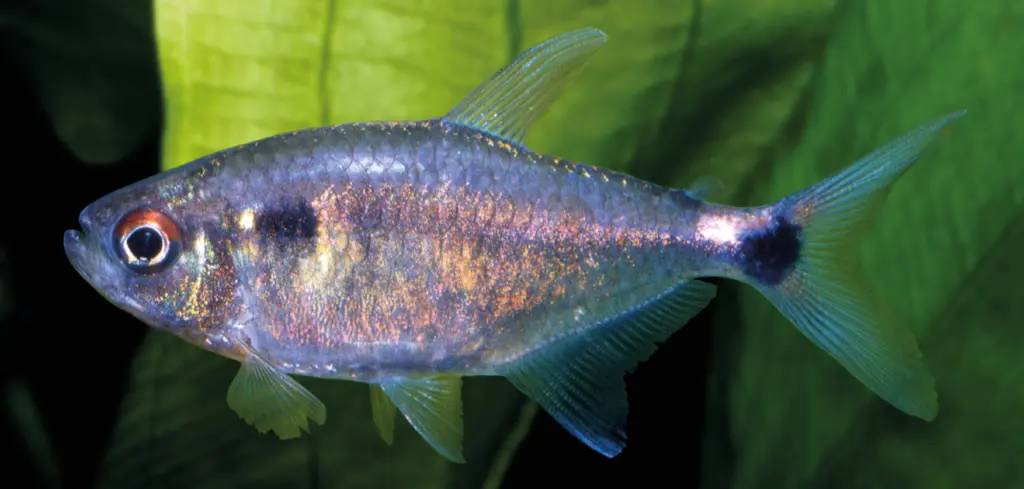
Hemigrammus ocellifer is a small characin from the family Characidae, widely distributed across the Amazon and Orinoco river basins in South America. Its common name comes from two distinctive reflective spots: one located on the upper gill cover behind the eye, and another at the base of the caudal fin. Under aquarium lighting, these spots shimmer like tiny beacons, giving a school of these fish an unmistakable charm.
In the aquarium, the Head-and-Tail Light Tetra reaches 4-5 cm in length and lives 5-7 years with proper care. The body is elongated and silvery with a subtle olive hue along the back. The fins are transparent. Sexual dimorphism is subtle: females are slightly fuller and rounder, especially before spawning. The fish is active during the day and tends to occupy the middle water layers.
Thanks to its peaceful temperament, modest size, and undemanding nature, Hemigrammus ocellifer is an excellent candidate for beginner aquarists and one of the most suitable species for a community aquarium.
Tank Requirements
The minimum tank volume for a school of Head-and-Tail Light Tetras is 60 liters. Like most small characins, these fish feel most comfortable in a group of 8-10 or more, so plan your tank around keeping them in a proper school.
Optimal water parameters are: temperature 22-28 °C, pH 6.0-7.5, and general hardness GH 4-15. These tetras are fairly adaptable, but they display their brightest coloration and most confident behavior in soft, slightly acidic water.
The aquarium should be densely planted with live plants such as Vallisneria, Cryptocoryne, and Java moss, while leaving enough open space for swimming. Subdued lighting and a dark substrate will highlight the shimmer of their reflective spots and bring out richer coloration. Floating plants help create the diffused light these forest stream inhabitants prefer. Water flow should be moderate, as strong currents are uncomfortable for this species.
Feeding and Diet
In the wild, Hemigrammus ocellifer feeds on small aquatic invertebrates, insect larvae, and plant-based detritus. In the aquarium, these fish are completely undemanding and readily accept all types of appropriately sized foods.
The staple diet can consist of high-quality flakes or micro-pellets designed for small tropical fish. Regularly supplement with live or frozen foods: daphnia, cyclops, brine shrimp, and small bloodworms. Such supplementation enhances coloration and keeps the fish in prime condition.
Feed 2-3 times daily in small portions that are consumed within 1-2 minutes. Overfeeding is a common beginner mistake: leftover food degrades water quality far more quickly than one might expect. A varied diet is the key to health and active behavior.
Care and Maintenance
The Head-and-Tail Light Tetra has a care level of 2 out of 5, making it one of the best species for beginner aquarists. The main requirement for successful keeping is stable water parameters and regular tank maintenance.
Perform weekly water changes of 20-25% of the tank volume. Ensure your filter provides effective biological and mechanical filtration. Monitor ammonia and nitrite levels, which should always read zero. Nitrates should ideally be kept below 20 mg/l.
The aquarium must be fully cycled before introducing the fish. When basic care guidelines are followed, Head-and-Tail Light Tetras rarely fall ill. However, sudden parameter fluctuations or maintenance in polluted water can trigger outbreaks of ich (white spot disease) and bacterial infections. Quarantining new fish before adding them to the main tank is a wise habit that prevents many potential problems.
Compatibility
Hemigrammus ocellifer is a peaceful species with an aggression level of 2 out of 5. It is an ideal community tank inhabitant that does not create conflicts with tankmates. In a school of 8 or more, these fish behave more confidently, and watching their coordinated movements is a true delight.
Excellent companions include other small, peaceful fish: the glowlight tetra, neon tetras, rasboras, and small rainbowfish. As bottom-dwelling tankmates, Corydoras catfish are a perfect match, sharing the same water parameter requirements. Peaceful dwarf cichlids and small gouramis also make good companions.
Avoid housing them with large or aggressive fish that might view the tetras as food or intimidate them. Large cichlids, paradise fish, and predatory species are unsuitable tankmates. Also avoid fish known for fin-nipping behavior.
Breeding
Breeding Hemigrammus ocellifer at home is rated 3 out of 5 in difficulty, making it a perfectly achievable goal for an aquarist with basic experience.
Prepare a separate breeding tank of 15-20 liters with soft, slightly acidic water: pH 6.0-6.5, temperature 26-28 °C, hardness GH 2-6. Lighting should be minimal, as eggs and fry are sensitive to bright light. Cover the bottom with fine-leaved plants (Java moss, Cabomba) or a spawning grid to protect the eggs from being eaten by the parents.
For a week before spawning, feed the breeding pair generously with live food such as brine shrimp and daphnia. Females can be distinguished from males by their more rounded belly. Place the pair in the breeding tank in the evening, and spawning typically occurs the following morning. The female scatters up to 200-300 small eggs among the plants.
After spawning, be sure to remove the adults, as Head-and-Tail Light Tetras, like most characins, will readily eat their own eggs. Larvae hatch within 24-36 hours, and after another 3-4 days the fry become free-swimming and begin to feed. Initial food should be infusoria or rotifers, transitioning to newly hatched brine shrimp after about a week.