Overview
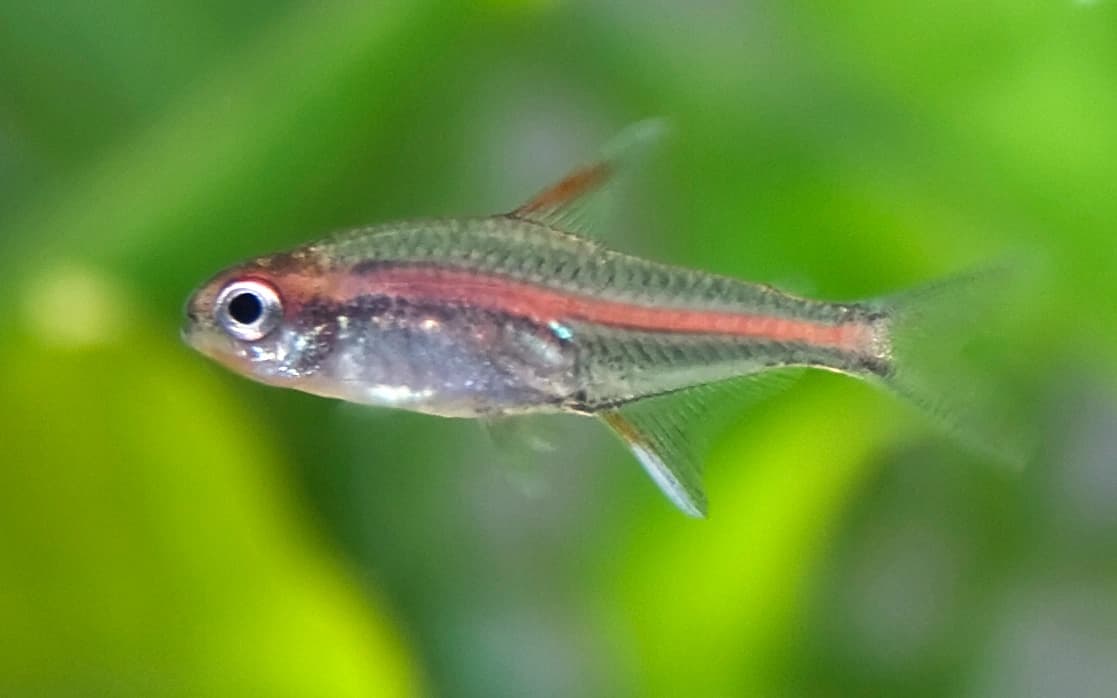
The Glowlight Tetra (Hemigrammus erythrozonus) is one of the most popular and recognizable small tetras in the aquarium hobby. This fish belongs to the Characidae family and is native to the rivers of Guyana, particularly the Essequibo River basin. In the wild, it prefers shaded areas of rivers and streams with soft, slightly acidic water, sheltered by tropical vegetation.
The defining feature of the Glowlight Tetra is its brilliant red-orange stripe that runs from the head to the tail. In subdued lighting, this stripe appears to glow, which is exactly how the fish earned its common name. The body is small, elongated, and slightly compressed laterally, reaching 4-5 cm in length. The overall coloration is semi-transparent, silvery-peach, creating a striking contrast with the vivid stripe. With proper care, the Glowlight Tetra can live for 5-7 years.
How to Distinguish Males from Females
- Size and body shape: Females are slightly larger and have a more rounded belly, especially during spawning season.
- Coloration: Males tend to be slimmer and display a more intense glowing stripe.
- Swim bladder: In males, the tip of the swim bladder is pointed, while in females it is rounded — this can be observed through their semi-transparent body.
Tank Requirements
A school of Glowlight Tetras requires an aquarium of at least 60 liters. Optimal water parameters are:
- Temperature: 22-28°C
- pH: 6.0-7.5
- Hardness (GH): 4-15
The aquarium should be planted densely while leaving enough open swimming space in the center. A dark substrate and subdued lighting will help enhance the brightness of the glowing stripe — this is when the fish look their most spectacular. Floating plants will create natural shade and reduce stress. Water flow should be gentle to moderate. Good filtration is essential, but avoid creating strong currents.
Feeding and Diet
In the wild, Hemigrammus erythrozonus feeds on small invertebrates, insect larvae, and plant microorganisms. In the aquarium, this fish is undemanding when it comes to food and readily accepts a variety of options:
- Staple diet: high-quality flakes and micro-pellets for small tropical fish
- Live and frozen foods: brine shrimp, daphnia, cyclops, bloodworms (small)
- Plant-based supplements: spirulina-enriched foods
Feed small portions 2-3 times a day, offering only as much food as the fish can consume within 2-3 minutes. A varied diet that includes live and frozen foods promotes vibrant coloration and strengthens the immune system.
Care and Maintenance
The Glowlight Tetra is an undemanding fish with a care level of 2 out of 5, making it an excellent choice for beginner aquarists. Key care guidelines include:
- Water changes: weekly changes of 20-25% of the aquarium volume
- Parameter monitoring: regular checks of temperature, pH, and water hardness
- Filtration: a quality filter with regular maintenance
- Substrate cleaning: gravel vacuuming during each water change
These fish are sensitive to sudden fluctuations in water parameters, so all changes should be made gradually. Under stable conditions, Glowlight Tetras rarely fall ill. The most common issues are related to declining water quality: fading coloration, loss of appetite, and increased susceptibility to infections.
Compatibility
The Glowlight Tetra is a peaceful schooling fish that should be kept in groups of 6-8 or more. In a school, these fish feel confident, display their natural behavior, and show their most vibrant coloration. Solitary specimens tend to become shy and pale.
Excellent tank mates for the Glowlight Tetra include:
- Other small tetras, including the Head and Tail Light Tetra
- Rasboras and danios
- Corydoras and other peaceful catfish
- Dwarf gouramis
- Small peaceful barbs
- Shrimp (Cherry, Amano)
Avoid keeping them with large or aggressive fish, as well as species known for fin-nipping. Large cichlids and predatory fish will see tetras as food.
Breeding
Breeding Hemigrammus erythrozonus at home is possible but requires some preparation. The breeding difficulty is rated 3 out of 5.
Setting up the breeding tank:
- A separate tank of 15-20 liters
- Temperature 26-28°C
- pH 6.0-6.5, soft water (GH 2-6)
- Dim lighting or complete darkness
- Fine-leaved plants (Java moss) or a spawning grid on the bottom
Breeding process:
Before spawning, separate the breeding pair for 7-10 days and feed them generously with live foods. Place the conditioned pair in the breeding tank in the evening — spawning usually occurs the following morning. The female will scatter 100-150 small eggs among the plants.
After spawning, the adults must be removed immediately, as they will actively eat their own eggs. The eggs are light-sensitive, so the breeding tank should be kept dark. Larvae hatch within 24-36 hours and begin free-swimming on days 3-4. Initial food should be infusoria and micro-worms, transitioning to newly hatched brine shrimp after about a week.