Overview
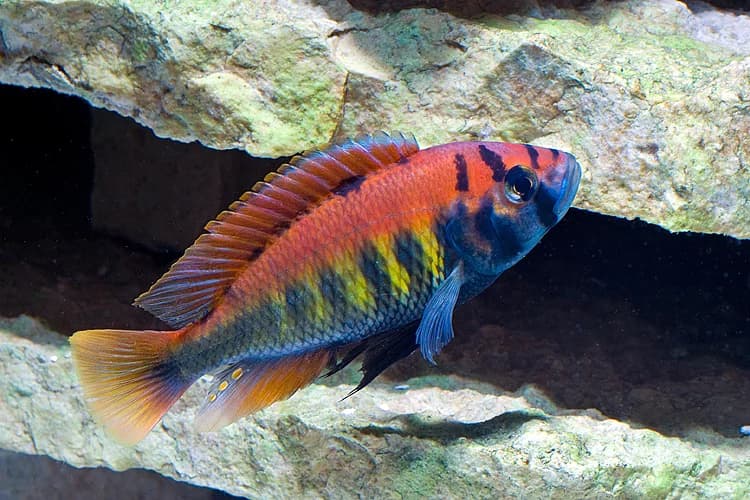
Haplochromis nyererei is one of the most vibrantly colored freshwater cichlids in the world, endemic to Lake Victoria in East Africa. The species is named after Julius Nyerere, the first president of Tanzania. This fish is living proof of just how incredible the color diversity of African cichlids can be.
The fish grows to 8–10 cm and lives 5–8 years with proper care. Sexual dimorphism is extremely pronounced: males boast a stunning coloration — a fiery red back and upper body that gradually transitions into bright yellow flanks and a bluish-green lower half. Dark vertical bars complement this palette. Females are considerably more subdued — silvery-olive with faint barring, typical of Lake Victoria haplochromines.
The behavior rating is 4 out of 5 — this is a territorial and quite aggressive cichlid, especially the males. Haplochromis nyererei actively defends its territory and may chase rivals persistently. This is a diurnal species, constantly in motion and exhibiting complex social behavior — watching them is endlessly fascinating.
In the wild, the species is threatened due to the introduction of the Nile perch, lake pollution, and eutrophication. Aquarium breeding plays an important role in preserving the gene pool of this magnificent species.
Tank Requirements
A group of Haplochromis nyererei requires an aquarium of at least 120 liters. The optimal setup is a harem of one male and 3–4 females. If you plan to keep multiple males, the volume should be significantly larger — 200 liters or more with abundant visual barriers.
Water parameters differ fundamentally from South American cichlids: temperature 24–28 °C, pH 7.5–8.5, and general hardness GH 8–15. This is alkaline, hard water — typical conditions of the great African lakes. If your tap water is soft, you will need buffering salts to maintain the correct parameters.
The setup should be a rocky biotope: piles of stones creating numerous caves, crevices, and hiding spots. Each rock formation is a potential territory, so the more shelters available, the more evenly aggression is distributed. Substrate should be fine sand or crushed coral (which helps maintain alkaline pH). Plants are not essential and often do not survive in alkaline water, though Anubias and Java fern attached to rocks can work.
Feeding and Diet
Haplochromis nyererei is an omnivorous cichlid. In the wild, the diet consists of small invertebrates, insect larvae, algal growth, and plankton.
In the aquarium, the staple diet should be high-quality pellets for African cichlids. Choose foods with moderate protein content and a mandatory vegetable component — this prevents bloat, to which many African cichlids are prone. Regularly offer spirulina flakes or tablets — they help maintain color vibrancy.
Live and frozen foods — brine shrimp, daphnia, cyclops, and small bloodworms — should be offered 2–3 times per week as a supplement. Avoid feeding tubifex worms — the risk of parasite transmission is high.
Feed twice daily in small portions. Males during courtship may chase females away from food, so scatter food across the entire water surface to ensure everyone gets their share. Do not feed a female incubating eggs in her mouth — she will not eat for 2–3 weeks, and this is a normal process.
Care and Maintenance
The care level for Haplochromis nyererei is rated 3 out of 5. The main challenges are maintaining alkaline water parameters and managing aggression.
Weekly water changes of 25–30% are mandatory. Filtration should be powerful with good biological media — an external canister filter is preferred. Aeration is essential: in Lake Victoria the water is oxygen-rich, and this species tolerates low oxygen poorly. Monitor parameters: ammonia and nitrites must be strictly at zero, nitrates below 25 mg/l.
The key aspect of husbandry is aggression management. A harem structure (1 male to 3–4 females) is the optimal approach. Two males in one tank will conflict constantly, and the dominant male may eventually kill the subordinate. Abundant hiding spots and visual barriers made of rocks are critically important for territory distribution.
Watch the condition of females: if one is constantly hiding, appears emaciated, or has tattered fins — this signals excessive harassment. In such cases, temporarily remove the female to a separate tank.
Compatibility
Haplochromis nyererei is a territorial cichlid with a behavior rating of 4 out of 5, and tankmate selection requires caution.
The best option is a species-only tank with one male and a group of females. This allows you to observe natural behavior without interspecific conflicts. If variety is desired, they can be kept with other robust Lake Victoria cichlids of similar size, provided the tank is sufficiently large (200 liters or more) with abundant hiding spots.
Housing with Lake Malawi cichlids is a debatable option. Species like Yellow Labs are relatively compatible thanks to similar water parameters, but there is a risk of hybridization and territorial conflicts.
Strictly avoid keeping with small peaceful fish — tetras, rasboras, and small catfish. They will be subjected to constant harassment. Housing with large aggressive cichlids that would dominate the Nyererei is also inadvisable.
Breeding
Breeding Haplochromis nyererei is rated 3 out of 5 in difficulty — with proper husbandry, these fish spawn readily and regularly. They are maternal mouthbrooders: the female carries eggs and fry in her mouth.
Spawning follows the typical haplochromine pattern: the male establishes a territory near a flat stone, displays his most intense coloration, and begins attracting a female with courtship dances. The female lays a small batch of eggs (typically 15–40), immediately takes them into her mouth, after which the male fertilizes them — the female "pecks" at the egg-shaped spots on the male's anal fin, picking up milt in the process.
Incubation lasts 2–3 weeks at a temperature of 26–28 °C. During this entire period, the female does not eat and holds the eggs, then larvae, in her mouth. Do not disturb an incubating female — stress may cause her to prematurely spit out or swallow the brood.
After release, the fry are already fairly large (about 8–10 mm) and can feed independently. First food should be baby brine shrimp, finely crushed pellets, and microworms. For maximum survival, it is best to move the incubating female to a separate tank a few days before fry release. Young fish grow quickly, and males begin showing color by 3–4 months of age.