Overview
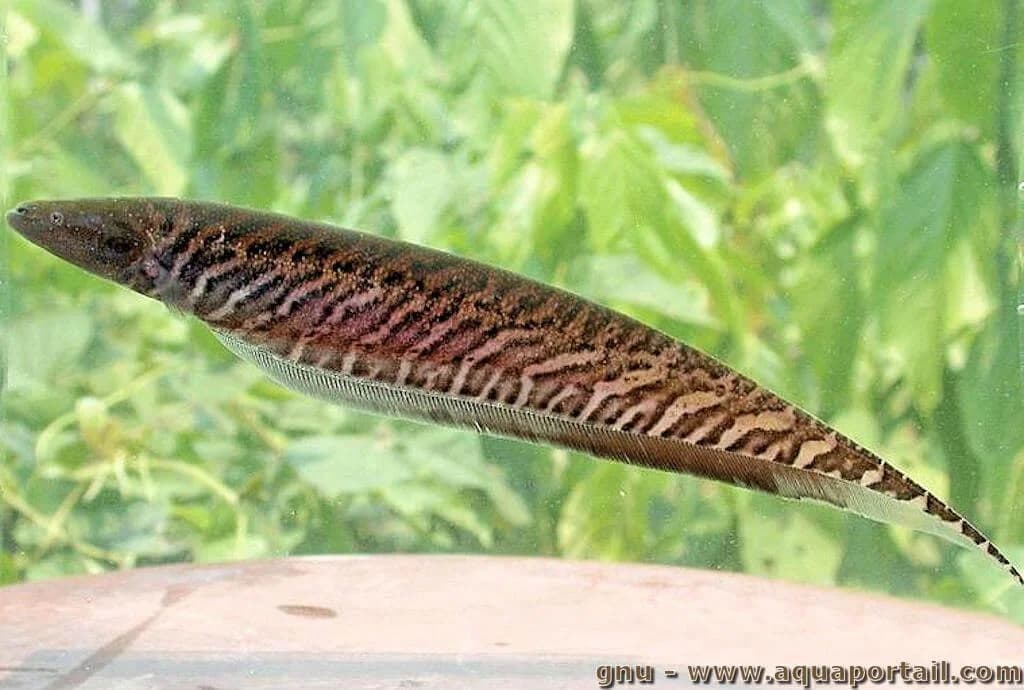
Gymnotus carapo, known as the Banded Knifefish or Striped Knifefish, is one of the most widespread members of the family Gymnotidae. Its range is remarkably broad: from Guatemala and Mexico through all of Central America to Argentina and Brazil. In the wild, the Banded Knifefish inhabits slow-moving rivers, swampy floodplains, flooded meadows, and canals, favoring areas with dense vegetation and soft muddy bottoms.
The body of Gymnotus carapo is elongated and laterally compressed, lacking both dorsal and caudal fins. The primary organ of locomotion is a long undulating anal fin that extends from the throat nearly to the tip of the tail. This remarkable adaptation allows the fish to move equally well forward and backward — a rare ability among freshwater species. The coloration is dark olive or brown with distinctive light vertical bands, which give the species its common name. Aquarium specimens typically reach 20–40 cm, though wild individuals can grow up to 76 cm. Lifespan is 5–10 years with proper care.
The defining feature of the Banded Knifefish is its ability to generate weak electric organ discharges (EOD). Unlike the electric eel, the discharges of Gymnotus carapo are harmless to humans and serve two purposes: electrolocation (navigating murky water and detecting prey) and communication with conspecifics. This trait makes the Banded Knifefish one of the most fascinating subjects for both aquarium keeping and scientific research.
Tank Requirements
Keeping Gymnotus carapo requires an aquarium of at least 200 liters for a single adult specimen. Given the fish's potential size and nocturnal activity, a tank of 300 liters or more with a length of at least 120 cm is preferable. Optimal water parameters are: temperature 23–28 °C, pH 6.0–8.0, and general hardness GH 5–15.
The aquarium setup should replicate the natural habitat. Numerous hiding places are essential: driftwood, large-diameter ceramic and PVC tubes, and rock formations creating caves. The Banded Knifefish is strictly nocturnal and spends the entire day in shelter — without suitable refuges, the fish will suffer chronic stress, leading to disease and refusal to feed.
The substrate should be soft — fine sand or smooth rounded gravel. The skin of Gymnotus species is scaleless, and rough substrate can cause injuries. Plants are desirable but not mandatory: the Banded Knifefish does not damage them, though its powerful body may accidentally uproot poorly anchored specimens. Hardy species such as Anubias and Java Fern attached to driftwood work well.
Lighting should be subdued. Floating plants — Pistia, Salvinia, or duckweed — will help create comfortable shade. A tight-fitting lid is essential: the Banded Knifefish may jump out of the water when startled.
Feeding and Diet
Gymnotus carapo is a pronounced predator. In the wild, it feeds on small fish, crustaceans, aquatic insects and their larvae, worms, and even small frogs. In the aquarium, the diet should consist primarily of live and frozen foods: bloodworms, earthworms, small shrimp, fish fillet pieces, krill, and tubifex.
It is important to remember that the Banded Knifefish will eat any fish that fits in its mouth. This is not aggression but natural predatory behavior.
Some individuals gradually adapt to quality sinking pellets designed for carnivorous fish, but dry food should not form the basis of the diet. Flakes and floating foods are unsuitable — Gymnotus feeds near the bottom and in the middle water layers.
Feeding should take place in the evening after the main lights are turned off, when the fish emerges from hiding. Young specimens should be fed daily, adults every other day or 3–4 times per week. Each portion should be consumed within 10–15 minutes. Overfeeding is dangerous: the Banded Knifefish is prone to obesity when insufficiently active.
Care and Maintenance
The Banded Knifefish is a demanding species recommended only for experienced aquarists (care level 4 out of 5). As with its relative the Black Ghost Knifefish, the absence of scales makes Gymnotus carapo especially sensitive to water quality and chemical treatments.
Weekly water changes of 25–30% are mandatory. Ammonia and nitrites must always remain at zero, and nitrates should not exceed 20 mg/l. Filtration should be powerful but without creating strong currents: an external canister filter is the optimal choice. Aeration is important, particularly at higher water temperatures.
When treating diseases, avoid copper-based and formalin medications — they are toxic to scaleless fish. Mild treatments at half dosage are preferable, and better still is prevention through maintaining ideal water conditions.
The electric field generated by the Banded Knifefish may create interference with electronic aquarium equipment. This factor should be considered when using electronic controllers and sensors.
Compatibility
Gymnotus carapo is a solitary and territorial species. Keeping multiple individuals in the same aquarium is highly inadvisable: their electric fields interfere with one another, leading to chronic stress and fierce conflicts. The aggression level is rated as moderate (3 out of 5) — the Banded Knifefish does not attack fish it does not consider prey or rivals, but at night any small fish becomes its meal.
Suitable tankmates are large and medium-large species that primarily inhabit the upper and middle water layers: Severums, large Angelfish, and Pearl Gouramis. Small fish (neons, guppies, small rasboras) are entirely unsuitable, as are other knifefish species, including the Black Ghost Knifefish — territorial conflicts between them are inevitable.
The best approach for keeping the Banded Knifefish is a species-only tank with a single specimen. This allows the fish to feel maximally comfortable and display its natural behavior.
Breeding
Breeding Gymnotus carapo in the aquarium is challenging but achievable for experienced breeders (difficulty 4 out of 5). In the wild, spawning is timed to the rainy season, when water levels rise and hardness decreases.
Sexual dimorphism in the Banded Knifefish is subtle: males are generally somewhat larger and heavier than females, and during the breeding season, females develop a noticeably rounded abdomen. Sex determination without experience is difficult.
To stimulate spawning, it is recommended to simulate the onset of the rainy season: gradually lower the temperature by 2–3 °C, then raise it to the upper end of the range while simultaneously performing large water changes with soft water. The breeding tank should be darkened with numerous hiding places.
A remarkable feature of Gymnotus carapo is its pronounced paternal care. The male guards the clutch and larvae, actively defending them against any threats. Fry become free-swimming 3–5 days after hatching. Starter foods include live baby brine shrimp and microworms, later progressing to small bloodworms. Fry growth is fairly rapid with good feeding, but juveniles should be sorted by size to prevent cannibalism.