Overview
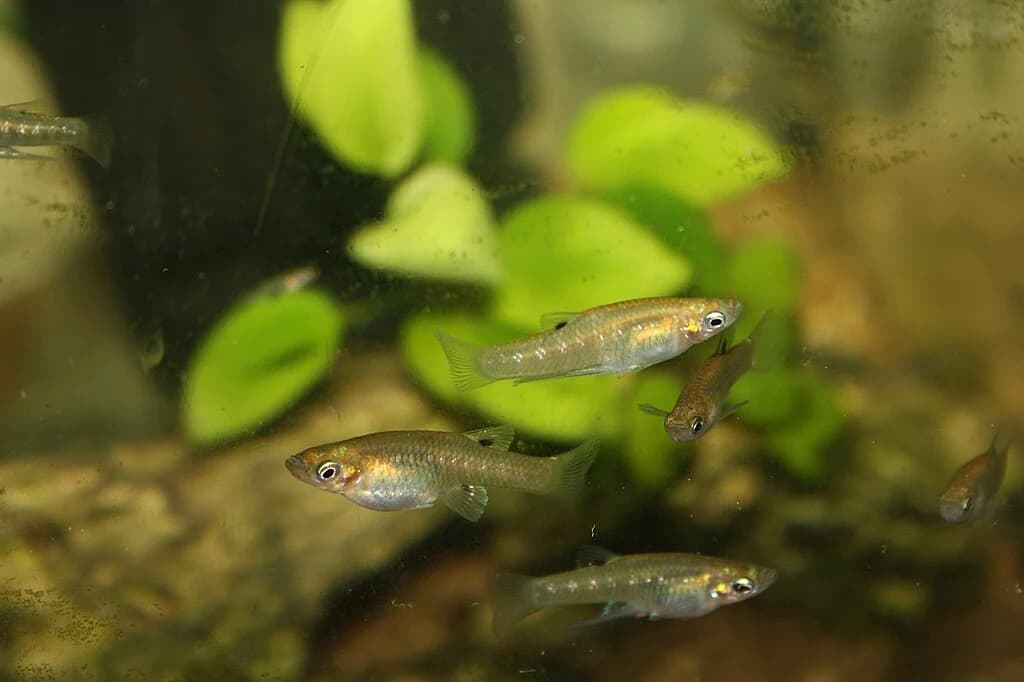
Girardinus metallicus is a small livebearer from the family Poeciliidae, endemic to the island of Cuba. In the wild, it inhabits slow-moving streams, canals, swampy areas, and small rivers with dense vegetation. This species was first described in 1854 and has since gained popularity among aquarists for its hardiness and interesting behavior.
The fish owes its name to the characteristic metallic sheen of its scales, which is particularly pronounced in males. The base coloration ranges from olive-silver to golden, with dark vertical bars running along the body. The species exhibits pronounced sexual dimorphism: males are significantly smaller than females, reaching about 4 cm in length, while females grow to 5 cm or more. In males, the anal fin is modified into a gonopodium — an organ for internal fertilization, which is a hallmark trait of all livebearers in the family Poeciliidae. Females have a more rounded body and less vivid coloration.
With proper care, Girardinus metallicus lives for 2–3 years. It is a diurnal, active fish that spends most of its time in the middle and upper water layers, exploring plant thickets.
Tank Requirements
A minimum tank volume of 50 liters is sufficient for keeping a small group of Girardinus metallicus. Despite the fish's modest size, it needs adequate swimming space and shelter.
Optimal water parameters:
- Temperature: 22–28°C (ideally 24–26°C)
- pH: 6.5–7.5
- General Hardness (GH): 5–15
The aquarium should be densely planted with live plants to closely replicate the fish's natural habitat. Vallisneria, Java moss, hornwort, and other fine-leaved plants work well. Dense vegetation provides shelter for females and fry while creating a natural microclimate. At the same time, leave open space in the center of the tank for active swimming.
Filtration should be moderate — Girardinus metallicus does not tolerate strong currents, as it naturally inhabits calm waters. A sponge filter or an internal filter with adjustable flow is the optimal choice. Additional aeration is beneficial but not strictly necessary if live plants are present. A dark substrate is preferable, as it makes the metallic sheen of the scales look most striking.
Feeding and Diet
Girardinus metallicus is an omnivorous fish with no special dietary requirements. In the wild, it feeds on small invertebrates, insect larvae, algae, and detritus.
In the aquarium, the staple diet can consist of high-quality dry food in the form of flakes or small granules designed for small tropical fish. To maintain health and vibrant coloration, supplement the diet regularly with live or frozen foods:
- Brine shrimp (Artemia) — an excellent source of protein
- Daphnia — promotes good digestion
- Bloodworm (small) — offered as an occasional treat
- Cyclops — well-suited for smaller individuals
- Blanched vegetables — zucchini slices, spinach, lettuce
Feed the fish 1–2 times per day in small portions that are consumed within 2–3 minutes. Overfeeding is a common mistake that leads to obesity and water quality degradation. A fasting day once a week is beneficial.
Care and Maintenance
Girardinus metallicus is an undemanding fish with a care level of 2 out of 5, making it an excellent choice for beginner aquarists. Nevertheless, basic care guidelines must be followed.
Weekly water changes of 20–25% are the key to maintaining fish health. Replacement water should be dechlorinated and brought to the aquarium temperature beforehand. Test water parameters regularly, paying particular attention to ammonia and nitrite levels, which should remain at zero.
The filter should be rinsed in aquarium water every 2–3 weeks to prevent clogging. The substrate should be vacuumed during water changes to remove accumulated waste.
The species is quite resistant to disease when kept in stable conditions. However, sudden temperature fluctuations or deteriorating water quality can make the fish susceptible to ich (white spot disease) and bacterial infections. Quarantining new inhabitants before adding them to the community tank is an essential preventive measure.
Compatibility
Girardinus metallicus has a peaceful temperament (aggression level 2 out of 5) and is well-suited for community tanks with other calm species of similar size.
It is best to keep these fish in groups of at least 6, with a predominance of females (a ratio of 1 male to 2–3 females) to reduce stress from excessive male attention.
Suitable tank mates:
- Other livebearers — guppies, platies, mollies
- Endler's livebearers — excellent companions of similar size
- Small tetras — neon tetras, cardinal tetras
- Peaceful bottom-dwellers — Corydoras catfish, Otocinclus
- Small rasboras
- Dwarf shrimp (cherry shrimp, Amano shrimp)
Not recommended to keep with:
- Large, aggressive cichlids
- Swordtails — may display dominance
- Large barbs — may nip fins
- Predatory species that would view the Girardinus as prey
Breeding
Breeding Girardinus metallicus is straightforward (difficulty level 2 out of 5) and often occurs spontaneously in community tanks. Like all members of the family Poeciliidae, this is a livebearer — females carry the fry inside their body and give birth to fully formed, free-swimming young.
Sexual maturity is reached at 3–4 months of age. Males are easily identified by their gonopodium — a modified anal fin used for fertilization. Gestation lasts approximately 28–30 days. A single brood can produce 10 to 30 fry, depending on the female's size and age. Notably, females can store sperm from a single mating and produce multiple broods from it.
To improve fry survival rates:
- Provide dense vegetation (especially moss and floating plants) where fry can take shelter
- Use a separate breeding tank of 10–20 liters
- Transfer the female a few days before delivery (identified by a greatly swollen belly and a dark gravid spot near the anal fin)
- Return the female to the community tank after delivery to prevent her from consuming the fry
Fry begin feeding immediately after birth. Suitable first foods include baby brine shrimp (Artemia nauplii), crushed flakes, or specialized fry foods. Feed 3–4 times daily in small portions. Fry grow quickly and reach adult size within 3–4 months with proper nutrition.
To maintain a healthy population, it is important to manage the sex ratio and prevent tank overstocking. Excess fry can be shared with fellow hobbyists or given to a local fish store.