Overview
Etroplus maculatus is a small, vibrant cichlid endemic to the fresh and brackish waters of India and Sri Lanka. This species belongs to the genus Etroplus, one of only three cichlid genera found in Asia. For aquarists, this is a particularly interesting fact: the vast majority of cichlids inhabit Africa and the Americas, making the Orange Chromide a rare representative of the Asian branch of this family.
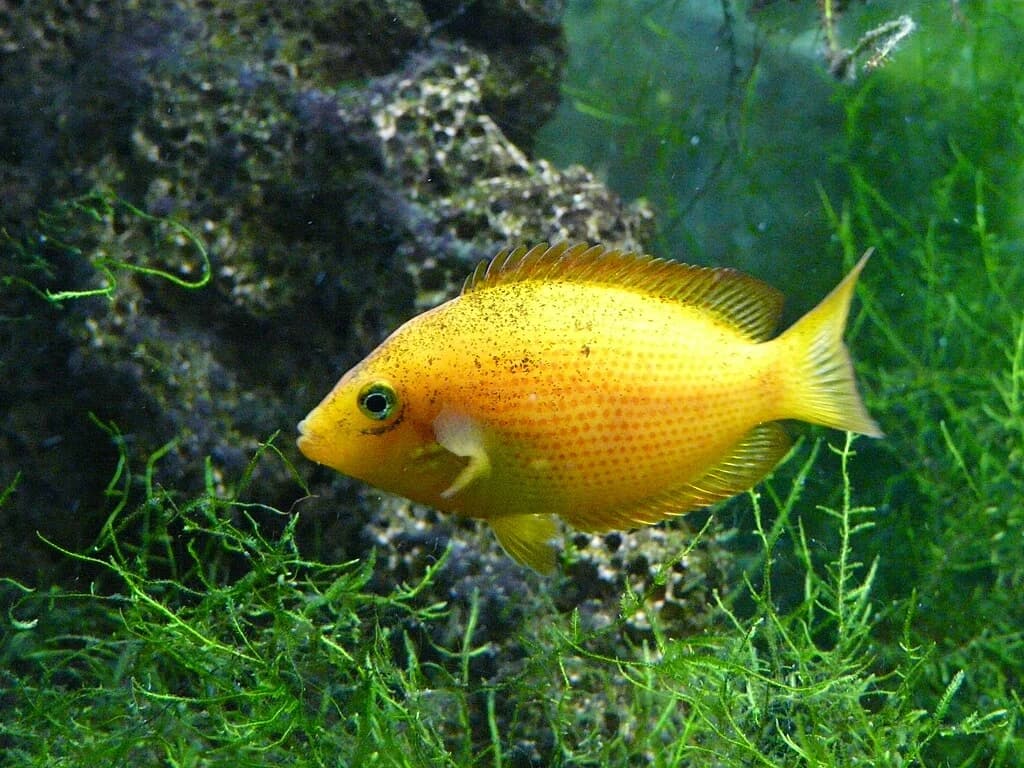
The fish grows to 8–10 cm and lives 5–7 years with proper care. The coloration ranges from bright orange to golden, with rows of small red or dark spots along the flanks that give the fish its "spotted" name. Color intensity depends on mood, keeping conditions, and season — during spawning, the fish become especially vivid. Several color forms exist, including a popular bright orange selectively bred morph.
The behavior rating is 2 out of 5 — this is one of the most peaceful cichlids, perfectly suited for a community aquarium. Territoriality is minimal and only increases during breeding. Etroplus maculatus displays well-developed parental behavior — both parents actively guard and care for their offspring, making observation a rewarding experience.
Tank Requirements
A pair or small group of Orange Chromides requires an aquarium of at least 100 liters. Optimal water parameters are: temperature 24–28 °C, pH 6.5–7.5, and general hardness GH 10–20. Note the relatively high hardness — this species prefers harder water than most South American cichlids.
An interesting feature: in the wild, Etroplus maculatus is often found in brackish water. A small addition of marine or aquarium salt (1–2 g/l) benefits the fish's health and boosts immunity, though this is not mandatory.
The setup should include abundant live plants, rocks, and driftwood providing hiding spots. Chromides do not damage live plants — an important advantage over many other cichlids. Vallisneria, Cryptocoryne, and Java fern all work well. Substrate should be sand or fine gravel. For spawning, provide flat stones or ceramic surfaces.
Water flow should be gentle or moderate. In nature, Chromides inhabit calm waters, and strong currents cause stress.
Feeding and Diet
Etroplus maculatus is an omnivorous cichlid with a notable proportion of plant matter in its diet. In the wild, it feeds on algae, small invertebrates, detritus, and plant material.
In the aquarium, the staple diet should be high-quality pellets or flakes for cichlids with plant-based components. Spirulina flakes and tablets are an excellent supplement that helps maintain vibrant coloration. Regularly offer frozen and live foods: daphnia, brine shrimp, bloodworms, and cyclops. Vegetable supplementation is also important: blanched spinach, peas, and finely chopped zucchini.
Feed twice daily in small portions consumed within 2–3 minutes. Orange Chromides eat at a leisurely pace, sampling each morsel, so when keeping them with more active fish, ensure food reaches everyone. Overfeeding should be avoided — moderation in diet promotes longevity.
Care and Maintenance
The care level for Etroplus maculatus is rated 3 out of 5. This is not a finicky species, but it requires stable parameters and attention to water quality.
Weekly water changes of 20–25% are mandatory. Filtration should be efficient but gentle — avoid strong currents. An internal filter or a small external with adjustable flow is the optimal choice. Monitor parameters: ammonia and nitrites must be strictly at zero, nitrates below 25 mg/l.
Orange Chromides are sensitive to sudden parameter swings and poor water quality. Under stress, their coloration fades and the fish become lethargic. Common diseases include fungal infections and fin rot, typically arising from a weakened immune system due to unstable conditions. Clean water and a varied diet are the best prevention.
Keep Chromides as a pair or in a small group of 4–6 individuals. A solitary fish will feel insecure and spend most of its time hiding. In a group, pairs form, and you can observe interesting social behavior.
Compatibility
Etroplus maculatus is one of the most peaceful cichlids with a behavior rating of 2 out of 5. It is perfectly suited for a community aquarium with other calm species of similar size.
Excellent companions include Pearl Gouramis, Dwarf Gouramis, Scissortail Rasboras, and Rosy Barbs. They coexist well with peaceful bottom dwellers: Bronze Corydoras and Striped Raphael Catfish.
Avoid housing with aggressive or large cichlids that would dominate the peaceful Chromides. Keeping with very small fish is also inadvisable — Chromides are not predatory, but during spawning they may show aggression toward small neighbors near their clutch. Tiger Barbs are poor companions due to their fin-nipping tendencies.
During breeding, a pair of Chromides becomes territorial and actively defends the area around their clutch, but this aggression is moderate and short-lived.
Breeding
Breeding Etroplus maculatus is rated 3 out of 5 in difficulty — quite achievable for an aquarist with basic experience. These are substrate spawners with pronounced parental care — one of the species' most fascinating features.
An established pair selects a flat stone, ceramic tile, or leaf of a large plant, meticulously cleans the surface, and begins spawning. The female lays 100–200 adhesive eggs in rows, which the male immediately fertilizes. To stimulate spawning, maintain temperature at 26–28 °C, pH 6.5–7.0, GH 10–15, and feed the breeders generously with live foods.
Both parents actively guard the clutch, fanning the eggs with their fins and removing dead ones. The larvae hatch in 3–4 days and become free-swimming after about a week. A unique trait — fry in their first days feed on the mucus secretion from their parents' skin, "nibbling" at the adults' flanks. This phenomenon, similar to Discus behavior, is a rarity among cichlids.
First food after transitioning to independent feeding should be baby brine shrimp, microworms, and finely crushed pellets. The parents continue guarding the young for several weeks. Fry grow at a moderate pace and reach 2–3 cm by 3–4 months of age.