Overview
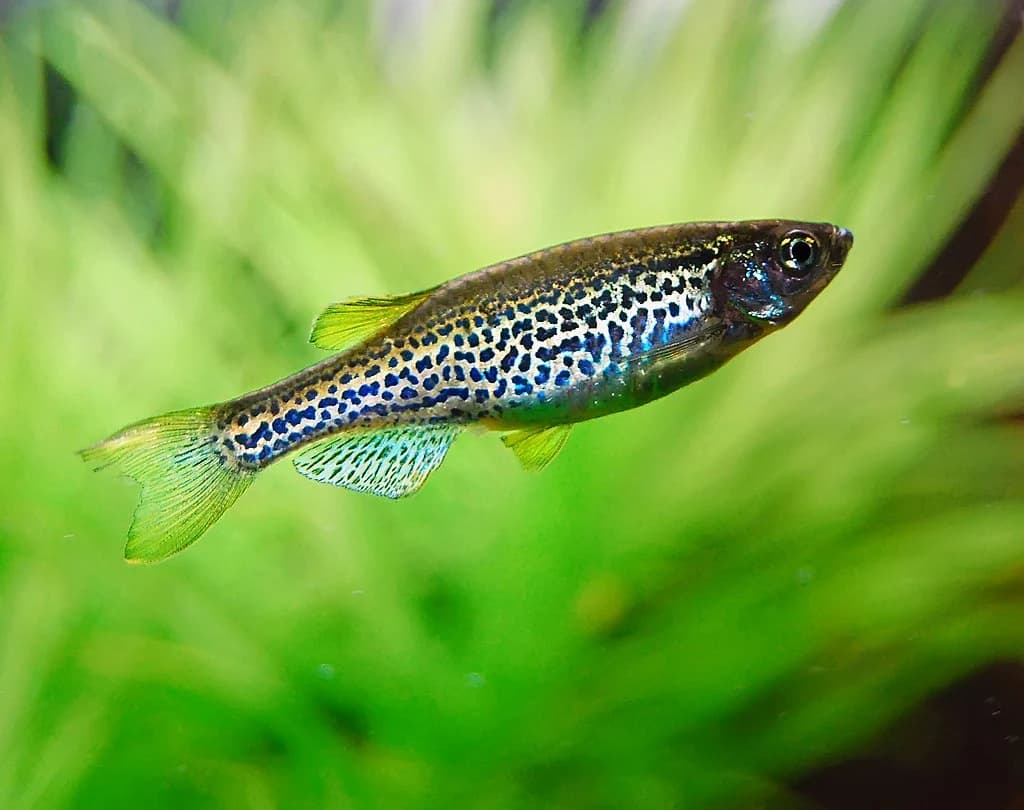
Danio frankei, known as the Leopard Danio, is one of the most recognizable fish in the Cyprinidae family. The defining feature of this species is its characteristic leopard pattern: numerous dark spots and speckles across a golden-yellow body, reminiscent of a leopard's coat. Unlike its closest relative, the Zebra Danio, which sports horizontal stripes, Danio frankei displays a distinctly spotted pattern that gave rise to its common name.
This species originates from Southeast Asia, where these fish inhabit shallow streams, rice paddies, and flooded areas with slow to moderate currents. In the aquarium hobby, the Leopard Danio has long earned its popularity thanks to incredible hardiness and undemanding nature — the care level is minimal, making it one of the best species for a first aquarium.
Adults reach 4-6 cm in length and live 3-5 years with proper care. These are active, lively fish that spend most of their day swimming through the middle and upper water layers. Watching a school of Leopard Danios is a true delight: their constant chasing and movement throughout the tank creates a vivid, dynamic display.
Tank Requirements
A school of Leopard Danios requires an aquarium of at least 50 liters. Despite their modest size, these fish are excellent swimmers and need sufficient space for free movement. A longer tank shape is preferable to a cube, as it allows the fish to build up speed and swim actively along the length.
One of the key advantages of Danio frankei is its remarkably wide temperature tolerance: 18-26°C. This allows them to be kept even without a heater in rooms with ambient temperature, significantly simplifying tank setup. The optimal water acidity is pH 6.5-7.5, and hardness is GH 5-15. These parameters are typical for most tap water supplies, making water preparation as straightforward as possible.
The aquarium should be equipped with a filter providing moderate flow to simulate their natural habitat conditions. Live plants are welcome as they provide shelter and help maintain water quality. However, it is important to leave enough open swimming space. A lid or cover glass is essential, as Leopard Danios are prone to jumping.
Feeding and Diet
The Leopard Danio is a completely undemanding omnivore when it comes to food. The staple diet can consist of high-quality flakes or small granules for tropical fish. These fish readily take food from the water surface and mid-water column, rarely picking it up from the bottom.
For variety and improved health, it is recommended to regularly supplement the diet with live or frozen foods: bloodworms, brine shrimp, daphnia, and cyclops. Such supplements are especially beneficial before breeding, as they improve the condition of spawning adults.
Plant-based foods should not be overlooked either: blanched spinach leaves, finely chopped zucchini, or specialized foods containing spirulina will help ensure balanced nutrition. Feeding is recommended 1-2 times daily in small portions that the fish consume within 2-3 minutes.
Care and Maintenance
Danio frankei is one of the most undemanding aquarium species, confirmed by its minimal care level rating. These fish have robust health and adapt well to various keeping conditions, forgiving beginners for minor mistakes.
The primary care rule is regular water changes: 20-25% of the volume weekly. This helps maintain stable water quality and prevents the accumulation of harmful substances. The filter should be rinsed as needed in aquarium water, ensuring its performance does not significantly decline.
It is important to remember that Leopard Danios are schooling fish and must be kept in a group of 6 or more individuals. In a small group or alone, they become timid, may experience stress, and can even display uncharacteristic aggression toward tankmates. In a proper school, the fish feel confident, display vibrant coloration, and exhibit their natural playful behavior.
Thanks to their wide temperature range (18-26°C), Leopard Danios can be kept in both heated tropical aquariums and room-temperature tanks, providing additional flexibility when choosing tankmates.
Compatibility
The Leopard Danio has a peaceful temperament and coexists wonderfully with most peaceful fish of similar size. Excellent tankmates include:
- other danio species: Zebra Danio, Glowlight Danio, Blue Danio;
- small rasboras: Scissortail Rasbora, Chili Rasbora;
- peaceful tetras: Neon Tetra, Ember Tetra;
- small catfish: Panda Corydoras, Pygmy Corydoras.
Avoid keeping them with large or aggressive species that may prey on danios or outcompete them during feeding. It is also not recommended to house them with slow-moving, long-finned fish, as active danios may nip their fins.
Leopard Danios primarily occupy the upper and middle water layers, making them an excellent complement to bottom-dwelling fish such as Sterba's Corydoras or Bronze Corydoras.
Breeding
Breeding Danio frankei is not particularly difficult and is quite accessible even for novice aquarists. These are egg-scattering fish — the female disperses eggs while the male fertilizes them during active courtship displays.
For spawning, it is best to prepare a separate tank of 10-20 liters with a water level of about 10-15 cm. The bottom should be covered with fine-leaved plants or a spawning grid through which the eggs can fall, remaining out of reach of the parents. This is important because Leopard Danios readily consume their own eggs.
Before spawning, condition the breeding pair for 1-2 weeks with generous live food feedings, then place them in the breeding tank in the evening. Spawning typically occurs in the morning at first light. After spawning is complete, the adults must be removed from the breeding tank immediately.
The eggs develop over 2-3 days at a temperature of 24-26°C. The newly hatched larvae feed on their yolk sacs for the first day, after which they should be fed infusoria or specialized liquid fry foods. After 7-10 days, the young fish can be transitioned to baby brine shrimp and later to finely crushed dry food.