Overview
Danio erythromicron is a miniature freshwater fish from the family Cyprinidae whose natural range is limited to a single body of water on the planet — the highland Inle Lake in Shan State, Myanmar. This endemic status makes the species particularly valuable in the aquarium hobby while also serving as a reminder of the importance of responsible fishkeeping.
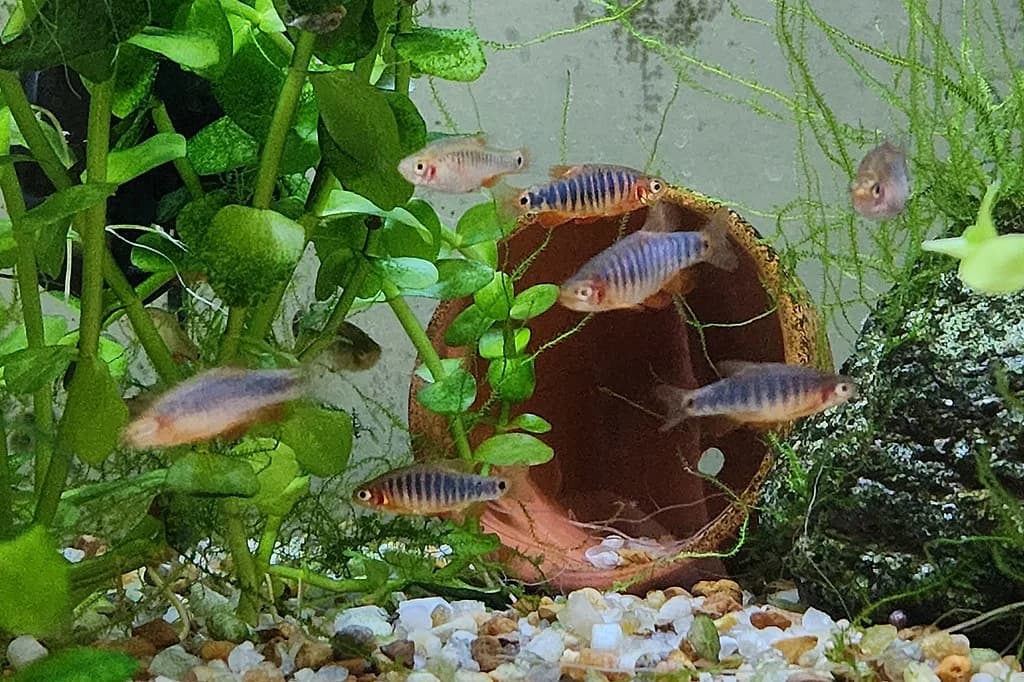
Adults reach only 2–3 cm in length, making them one of the smallest representatives of the genus Danio. The body is adorned with alternating vertical bars of emerald green and dark hues, creating a distinctive "tiger" pattern. The fins carry a subtle orange-red tint, especially noticeable in males during spawning season. Thanks to this striking coloration, the species has earned the trade names "Emerald Dwarf Rasbora" and "Emerald Dwarf Danio."
In my experience, Danio erythromicron is one of the best candidates for a nano aquarium. The fish are active during the day, typically occupy the middle water column, and display fascinating schooling behavior. They look stunning in a densely planted tank where their emerald bars shimmer against the greenery. In terms of care requirements, this species is similar to celestial pearl danio and glowlight danio, with which beginners often confuse them.
Tank Requirements
Despite their tiny size, Danio erythromicron requires a tank of at least 40 liters. This is because the fish must be kept in a school, and stable water parameters are easier to maintain in an adequate volume.
A key aspect of their care is that this species prefers cooler water. The optimal temperature is 20–24 °C, noticeably lower than most tropical aquarium fish. In Inle Lake, situated at approximately 900 meters above sea level, the water is never excessively warm. Overheating above 26 °C can cause stress and shorten the fish's lifespan.
Recommended water parameters:
- Temperature: 20–24 °C
- pH: 6.5–7.5
- General Hardness (GH): 5–15
The tank should be densely planted with live plants — Java moss, hornwort, and cryptocorynes work well. Floating plants (water lettuce, riccia) will help create the soft, diffused lighting these fish prefer over bright light. Be sure to leave open swimming areas in the middle of the tank. A dark substrate is recommended, as it brings out the fish's coloration far more vividly.
Feeding and Diet
In nature, Danio erythromicron feeds on small invertebrates and zooplankton. In the aquarium, the diet must account for the tiny mouth of these fish — they simply cannot swallow large foods.
The staple diet may include:
- Dry foods: micro-pellets and finely crushed high-quality flakes
- Live foods: baby brine shrimp (artemia nauplii), microworms, daphnia
- Frozen foods: small artemia, cyclops, daphnia
I recommend feeding small portions 2–3 times daily. From practical experience, live and frozen foods are what produce the most vibrant coloration. Artemia nauplii are arguably the best food for this species — they are the perfect size and eagerly consumed. Make sure all food is eaten within a few minutes, as leftovers quickly foul the water in small tanks.
Care and Maintenance
Danio erythromicron is a species with modest care requirements (care level 2 out of 5), yet it is sensitive to sudden fluctuations in water parameters. Stability is the golden rule of successful keeping.
Weekly water changes of 20–25% are essential. Use water that has been prepared in advance and brought to the correct temperature — even a small swing of 2–3 degrees can cause stress. Filtration should be effective but gentle — an air-driven sponge filter is ideal. Strong currents are undesirable for these small fish.
Test the water regularly for ammonia and nitrites — in small tanks these levels can spike quickly. With proper care, the lifespan is 3–5 years, which is quite respectable for such a miniature species.
Note that Danio erythromicron are shy fish that may hide during the first days after introduction. Dense planting and the presence of a school of conspecifics will help them acclimate faster and begin displaying their natural behavior.
Compatibility
Danio erythromicron is a peaceful species with an aggression rating of 2 out of 5. They should be kept in a school of 6 to 10 individuals — only in a group will the fish feel confident, display their full color palette, and exhibit natural behavior. In a small group or kept singly, they become timid and pale.
Ideal tankmates are other small, peaceful fish with similar water parameter requirements:
- Celestial pearl danio (Danio margaritatus)
- Chili rasbora (Boraras brigittae)
- Tinwini danio (Danio tinwini)
- Small corydoras species
Excellent compatibility is observed with freshwater shrimp — Neocaridina and Caridina species. Thanks to their tiny mouth, Danio erythromicron poses no threat even to juvenile shrimp, making this species a welcome inhabitant of shrimp tanks.
Housing with large or active fish is strongly discouraged — they will either view the erythromicrons as prey or overwhelm them with their presence.
Breeding
Breeding Danio erythromicron in the aquarium is entirely achievable, though it requires some preparation (breeding difficulty 3 out of 5). This species is an egg scatterer and shows no parental care.
For spawning, prepare a separate tank of 10–20 liters with soft, slightly acidic water:
- pH: 6.0–6.5
- Temperature: 23–25 °C
- GH: 4–8
Place fine-leaved plants on the bottom (Java moss is the best choice) or synthetic spawning mops. A mesh screen on the bottom will protect the eggs from being eaten by the parents. Lighting should be subdued.
Select a well-conditioned female with a rounded belly and the most brightly colored male. Spawning typically occurs in the morning hours — the female scatters small, transparent eggs among the plants while the male fertilizes them immediately. After spawning, the adults must be removed promptly.
The eggs incubate for 2–3 days. The newly hatched larvae feed on their yolk sac for the first day, after which they should be fed infusoria or specialized liquid fry food. After 7–10 days, the fry transition to artemia nauplii. Growth is slow, which is typical for such small species.