Overview
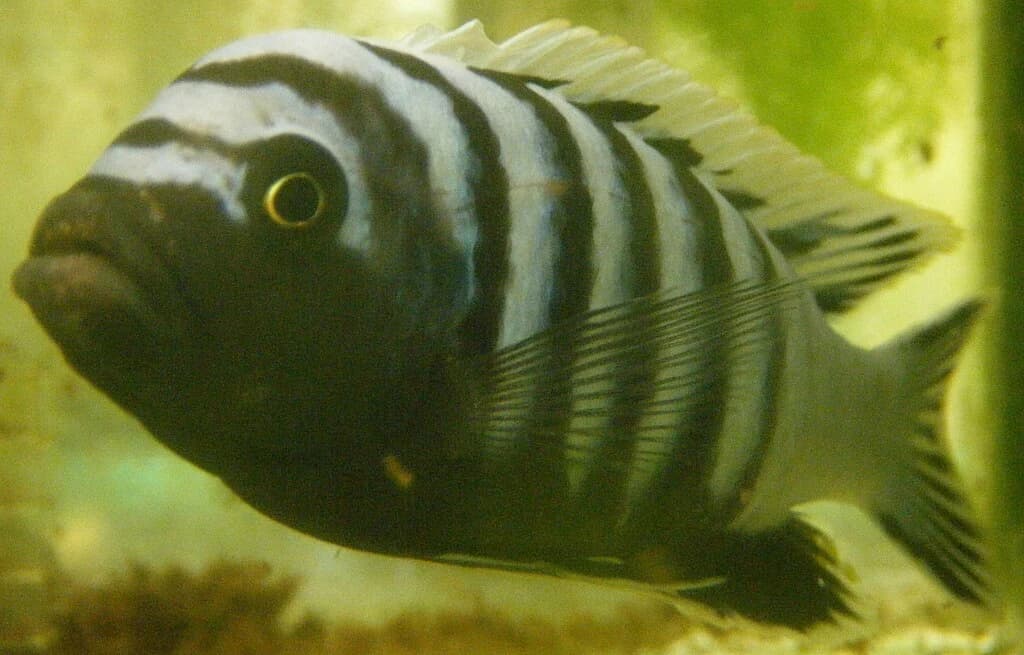
The Afra Cichlid (Cynotilapia afra) is a small yet striking fish from the mbuna group, inhabiting the rocky biotopes of Lake Malawi in East Africa. Adults reach 7–10 cm in size, making this one of the more compact mbuna species. The defining feature of the Cynotilapia genus is its unicuspid teeth, unlike the bicuspid teeth found in most other mbuna. It is this trait that earned the fish its common name — the dogtooth cichlid.
In the wild, Cynotilapia afra is found across numerous localities along the shores of Lake Malawi, and each population displays its own distinct color morph. Among the best known are "Cobue", "Jalo Reef", "Luwino", "Hai Reef", and many others. Male coloration ranges from deep blue with dark vertical bars to soft blue with yellow accents, depending on the specific morph. Females are typically more subdued, displaying grayish-brown tones. With proper care, these fish live 5–8 years.
Tank Requirements
A minimum tank volume of 150 liters is required for keeping Cynotilapia afra. As typical Lake Malawi inhabitants, these fish need alkaline water with the following parameters: temperature 24–28°C, pH 7.8–8.6, and general hardness (GH) 10–20. Stability of water parameters is of paramount importance — sudden fluctuations can cause stress and disease.
The key element of the tank setup is rock formations with plenty of caves, crevices, and hiding spots. This closely replicates their natural biotope — rocky shorelines with piles of boulders. Each fish will attempt to claim its own territory, so the more hiding places available, the fewer conflicts will arise. Sand or fine coral substrate works best as the bottom layer, additionally helping to maintain the alkaline environment. Powerful filtration and aeration are essential, as mbuna are sensitive to water quality.
Feeding and Diet
In the wild, Cynotilapia afra feeds primarily on zooplankton caught in the water column near rocks, as well as algae scraped from rocky surfaces. This sets it apart from many purely herbivorous mbuna species.
In the aquarium, the diet should be based on high-quality spirulina-based foods — pellets or flakes. Spirulina provides the necessary plant component and helps maintain vibrant coloration. Supplement the diet with frozen or live brine shrimp, daphnia, and cyclops. Feed small portions 2–3 times per day.
It is important to avoid foods high in animal protein and fats — beef heart, large quantities of bloodworms, and similar products can trigger Malawi bloat, a dangerous digestive disease common among mbuna. If you notice abdominal swelling, refusal to eat, or discolored feces, immediately isolate the fish and adjust the diet.
Care and Maintenance
Cynotilapia afra is a fairly hardy fish with moderate care requirements, but neglecting basic husbandry can quickly lead to problems. Weekly water changes of 25–30% are mandatory. Use test kits to regularly check pH, ammonia, nitrite, and nitrate levels.
Monitor the condition of rock structures — over time, food debris and waste can accumulate in hiding spots. Periodically vacuum the substrate with a siphon, paying attention to spaces between rocks. The filter should provide a turnover rate of at least 6–8 tank volumes per hour.
Watch for behavioral changes: refusal to eat, rapid breathing, loss of color, or isolation from the group can all indicate stress or illness. When keeping mbuna, it is useful to have bacterial infection treatments and antiparasitic medications on hand.
Compatibility
Cynotilapia afra displays moderate aggression typical of mbuna. Males actively defend their territory, especially during spawning. The optimal keeping strategy is a harem of one male with 3–4 females. This reduces pressure on individual fish and minimizes intraspecific aggression.
Good tankmates include other mbuna of similar size and temperament: Electric Yellow Cichlid, Zebra Mbuna, and Demasoni Cichlid. Avoid keeping them with overly aggressive species such as Auratus Cichlid, which can dominate more peaceful fish. Likewise, do not house them with small or slow-moving species that would become targets of harassment.
An effective technique for reducing aggression in a mbuna tank is moderate overstocking. When the tank contains a sufficient number of fish, aggression is dispersed and no single individual is subjected to constant harassment. However, overstocking demands enhanced filtration and more frequent water changes.
Breeding
Breeding Cynotilapia afra in the aquarium is not particularly difficult when basic conditions are met. Like all mbuna, these fish are maternal mouthbrooders: the female carries the fertilized eggs in her mouth for 18–25 days.
To stimulate spawning, maintain the water temperature at the upper end of the acceptable range (26–28°C) and provide a nutritious diet. The male displays vibrant coloration and actively courts females toward a chosen site on a flat rock or inside a shelter. After the eggs are laid and fertilized, the female collects them into her mouth.
During incubation, the female barely eats, so it is important that she is in good condition before spawning. Do not disturb a brooding female — stress can cause her to spit out the eggs prematurely. If needed, the female can be moved to a separate tank for undisturbed incubation.
Once released, the fry are large enough to immediately accept artemia nauplii and finely crushed spirulina-based food. The juveniles grow quickly and begin showing coloration characteristic of their specific color morph by 3–4 months of age.