Overview
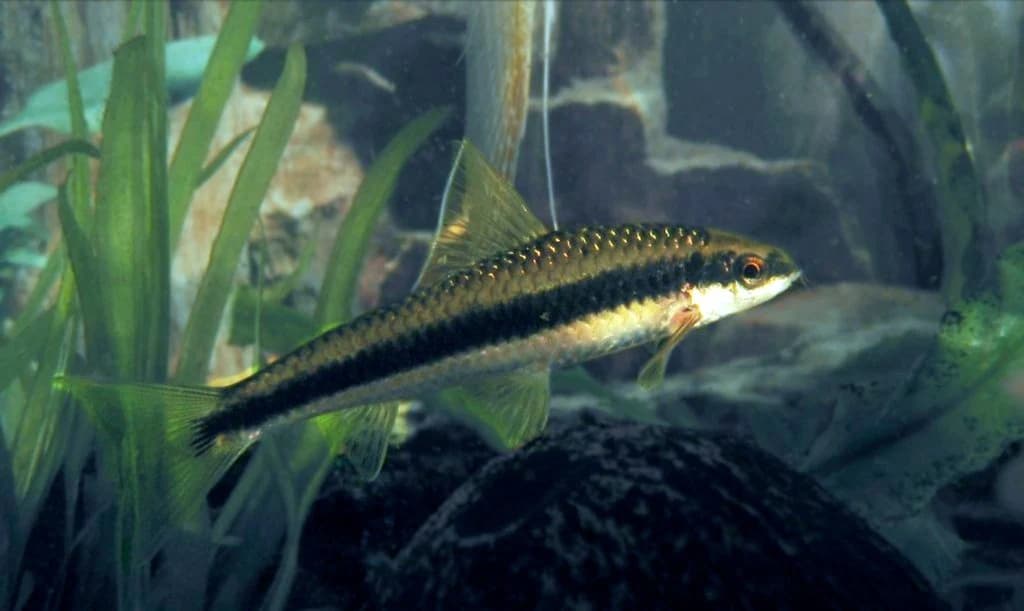
The Siamese Algae Eater (Crossocheilus oblongus) is a freshwater fish from the Cyprinidae family, native to rivers and streams of Southeast Asia, primarily Thailand and Malaysia. This fish reaches 10-15 cm in size and lives 5 to 7 years with proper care.
The main feature of Crossocheilus oblongus is its outstanding ability to consume algae. It is one of the few aquarium fish that actively eats black beard algae (red algae), making it an invaluable helper in keeping the aquarium clean. However, it is worth noting that as the fish ages, it loses interest in algae and increasingly switches to regular aquarium foods.
It is important to be able to distinguish the true Siamese Algae Eater from similar species. In Crossocheilus oblongus, a black horizontal stripe runs from the tip of the snout to the end of the caudal fin, with the edges of the stripe being zigzag-shaped. In the true Siamese crossocheilus, the stripe has smoother edges. In the false algae eater (Garra cambodgiensis), the black stripe ends at the base of the tail and does not extend onto the fin. Correct identification matters because false algae eaters are significantly less effective at controlling algae.
Tank Requirements
The Siamese Algae Eater requires an aquarium with a minimum volume of 150 liters. Optimal water parameters are: temperature 24-28°C, pH 6.5-7.5, and general hardness (GH) 5-15 dGH. The fish prefers clean, well-oxygenated water with moderate to strong current, which closely replicates its natural habitat in fast-flowing rivers.
The aquarium should be equipped with dense vegetation, driftwood, and rocks to create hiding spots. At the same time, it is important to leave enough open space for swimming. Siamese Algae Eaters are excellent jumpers, so the aquarium must be fitted with a tightly closing lid. Without a lid, the fish can easily jump out of the water, especially during stressful situations.
Feeding and Diet
In nature, Crossocheilus oblongus is primarily herbivorous, feeding on algae, periphyton, and plant debris. When young, the fish is especially active at consuming algae, including filamentous algae and black beard algae. With age, the appetite for algae decreases, and the fish more readily accepts regular aquarium foods.
In the aquarium, the diet should be based on high-quality plant-based foods: spirulina tablets, pellets for herbivorous fish, and blanched vegetables such as zucchini, cucumber, and spinach. Live and frozen foods (bloodworms, brine shrimp) can be offered as a protein supplement, but in moderation. Feed once or twice daily in small portions that the fish can consume within a few minutes.
Care and Maintenance
The Siamese Algae Eater is an undemanding fish with a care level of 2 out of 5, making it suitable for beginner aquarists. The main care requirements involve maintaining stable water parameters and performing regular water changes (20-30% of volume weekly). Effective filtration with good water flow is essential, as the fish does poorly in stagnant water.
It is recommended to keep Siamese Algae Eaters in groups of 3-5 individuals, which reduces stress and distributes any territorial aggression among the fish. Solitary specimens often become timid or, conversely, overly territorial. It is important to remember that with age, the fish may exhibit territorial behavior, particularly toward conspecifics and species with similar body shapes. Providing sufficient hiding spots and space helps minimize conflicts.
Compatibility
Crossocheilus oblongus is a peaceful fish (aggression level 2 out of 5) well suited for a community aquarium. It coexists excellently with most peaceful medium-sized species: barbs, rasboras, tetras, corydoras, and peaceful cichlids. It is not recommended to keep them with red-tailed black sharks, as both species may compete for territory due to similar body shapes and behavior. Conflicts are also possible with Chinese algae eaters, since both species occupy the same ecological niche.
Avoid keeping them with large aggressive species that may intimidate the algae eater. Very small fish (neon tetras, microrasboras) should be chosen with caution — although Crossocheilus oblongus is not a predator, a large adult specimen may inadvertently disturb small tankmates.
Breeding
Breeding Crossocheilus oblongus in home aquariums is moderately challenging (difficulty level 3 out of 5) and is rarely accomplished by hobbyists. In the wild, spawning occurs during the rainy season when the fish migrates upstream. Replicating such conditions in an aquarium is difficult.
To stimulate spawning, a spacious breeding tank with increased water flow and slightly lowered temperature (22-24°C) is needed, followed by a gradual increase to 26-28°C. The breeders lay adhesive eggs on plants and smooth surfaces. After spawning, adults should be removed to prevent them from eating the eggs. Fry become free-swimming after 3-4 days and require starter foods such as infusoria and brine shrimp nauplii. Most Siamese Algae Eaters available in the trade are raised on commercial farms using hormonal stimulation.