Overview
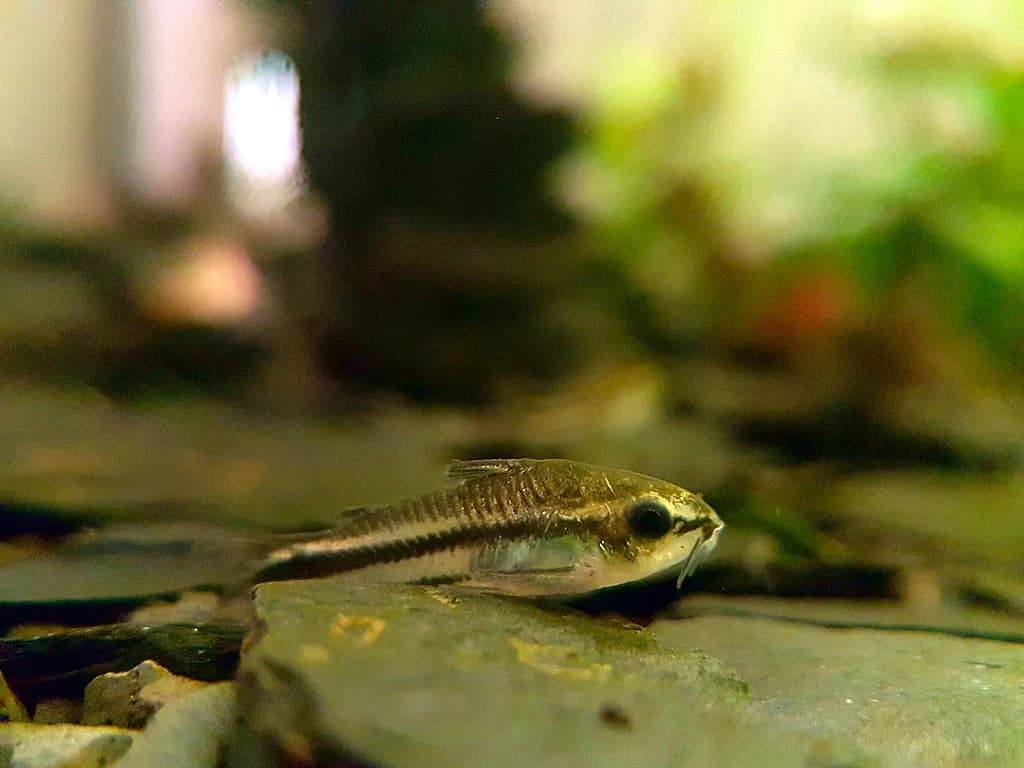
Corydoras pygmaeus is one of the smallest members of the Corydoras genus, belonging to the family Callichthyidae. In the wild, this species inhabits the Rio Madeira basin — a major tributary of the Amazon in Brazil. Adults reach only 3–4 cm in length and live 3 to 5 years with proper care.
The key trait that sets Corydoras pygmaeus apart from most other corydoras is its tendency to swim in the midwater column. While their larger relatives, such as the panda corydoras or the bronze corydoras, spend most of their lives near the bottom, pygmy corydoras form tight schools and hover in the middle of the water column, resembling small characins in their behavior. The body is silvery-grey with a distinctive dark horizontal stripe running from the snout to the base of the tail.
Thanks to their miniature size and peaceful temperament, Corydoras pygmaeus is an excellent choice for nano tanks and is ideal for aquarists who want to observe an active schooling fish in a smaller setup.
Tank Requirements
A tank of at least 60 liters is recommended for a group of Corydoras pygmaeus. Despite their small size, they need sufficient space for schooling in the midwater layer.
Optimal water parameters:
- Temperature: 22–26 °C
- pH: 6.0–7.5
- General Hardness (GH): 2–12 dGH
Fine sand is the best substrate choice — it is safe for the delicate barbels when the fish descend to the bottom to forage. The tank should be densely planted while still providing enough open swimming space in the middle area. Floating plants help create soft, diffused lighting under which the school feels more confident. Driftwood, rocks, and small hiding spots complete the setup and give the fish a place to retreat when needed.
Water flow should be gentle to moderate. A sponge filter (air-driven) is the ideal filtration choice: it provides gentle current, good aeration, and poses no risk to fry if the fish begin to breed.
Feeding and Diet
Corydoras pygmaeus is an omnivorous species. In nature, these tiny catfish feed on microscopic invertebrates, microorganisms, and organic particles both in the water column and near the substrate.
In the aquarium, it is important to account for the very small mouth of these fish. Suitable foods include:
- Staple diet: high-quality sinking micro-granules or crushed flakes
- Live and frozen foods: baby brine shrimp (artemia nauplii), microworms, grindal worms, small cyclops
- Supplementary: finely grated catfish tablets
Feed small portions 1–2 times per day. Make sure the food is fine enough — large pellets and whole bloodworms are not suitable for pygmies. Baby brine shrimp are one of the best foods, especially for conditioning fish before spawning.
Care and Maintenance
Corydoras pygmaeus is a relatively undemanding species (care level 2 out of 5), but several points deserve attention.
Weekly water changes of 20–25 % will help maintain stable parameters. These catfish are sensitive to elevated nitrate and ammonia levels, so regular water quality monitoring is essential. A sponge filter only needs to be rinsed in removed tank water every 1–2 weeks.
Corydoras pygmaeus should be kept in a group of at least 10 individuals — in such a school, the fish display the most natural behavior, experience less stress, and swim more actively in the midwater layer. In smaller groups, they become timid and spend most of their time hiding.
Pay attention to barbel health: if the substrate is sharp or dirty, the barbels may erode, signaling problems with husbandry conditions. A sandy substrate and clean tank bottom will help prevent this.
Compatibility
With their peaceful temperament (aggression level 2 out of 5), Corydoras pygmaeus coexist well with other small, calm species. However, due to their miniature size, tankmates must be chosen carefully.
Ideal tankmates:
- Small rasboras, such as Brigittae rasbora
- Small tetras, such as green neon tetra or ember tetra
- Small peaceful shrimp (Neocaridina)
- Other dwarf corydoras species
Unsuitable tankmates:
- Large or boisterous fish (cichlids, large barbs)
- Aggressive species that may intimidate the small catfish
- Predatory fish for which pygmies could become prey
Large or assertive fish easily stress Corydoras pygmaeus, causing the school to hide and lose its characteristic midwater activity. These catfish show their best behavior in a species-only tank or alongside similarly sized peaceful fish.
Breeding
Breeding Corydoras pygmaeus in the aquarium is quite achievable, though it requires some preparation (breeding difficulty 3 out of 5).
To stimulate spawning:
- Maintain a group with more males than females (a ratio of 2 males per 1 female)
- Feed live foods generously (baby brine shrimp, microworms) for 1–2 weeks
- Perform a large water change (up to 50 %) with water 2–3 °C cooler — this mimics the onset of the rainy season
The female deposits small batches of adhesive eggs (typically 1–2 at a time) on plant leaves, tank walls, or other smooth surfaces. The total number of eggs per spawning event can reach 30–50.
It is recommended to transfer the eggs to a separate container with water from the main tank and gentle aeration. Adding a few drops of methylene blue will help prevent fungal infection. Fry hatch after 3–4 days and begin feeding independently about a day later. First food should be infusoria and microworms; after about a week, they can be transitioned to baby brine shrimp.