Overview
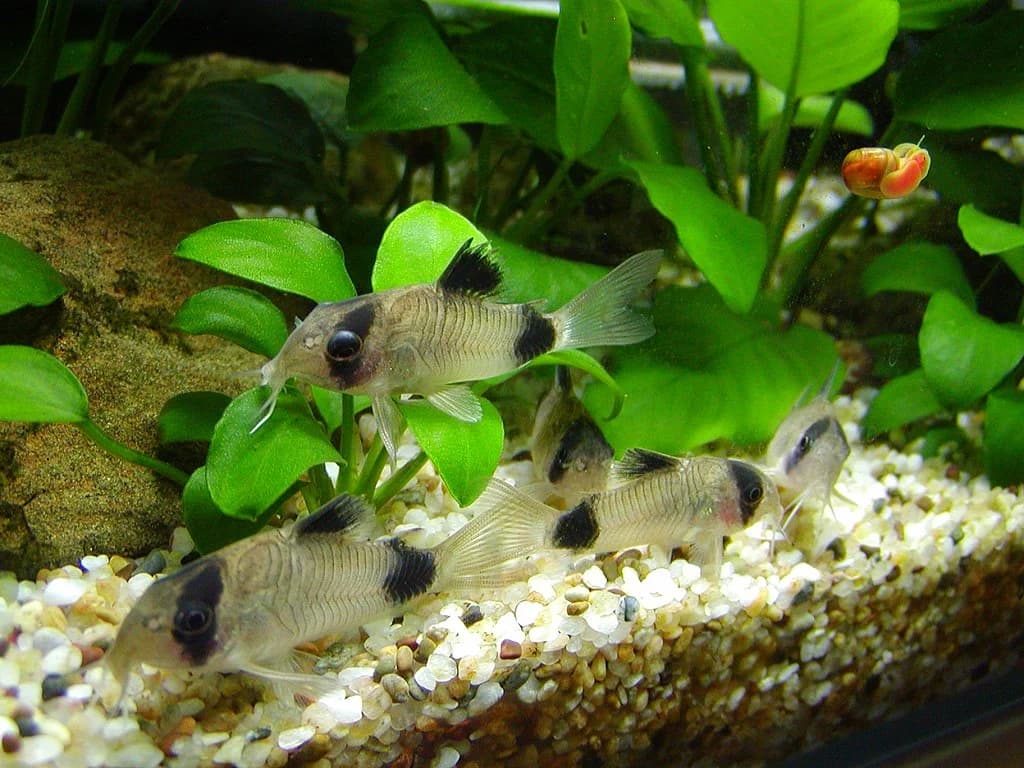
Corydoras panda is a small freshwater catfish from the family Callichthyidae, named after the giant panda due to the striking dark patches around its eyes, on the dorsal fin, and at the base of the tail that contrast sharply with its light body. In the wild, this species inhabits the Ucayali River basin in Peru, where it lives in cool tributaries with clear water and moderate current.
Adults reach 5-6 cm in length and live for 3 to 5 years with proper care. Corydoras panda is a shoaling fish with pronounced social behavior: the catfish constantly interact with each other, explore the bottom together, and rest as a group. Thanks to their peaceful nature and attractive appearance, this species has become one of the most popular corydoras in the hobby, alongside Sterba's Cory and the Bronze Corydoras.
Tank Requirements
A group of Corydoras panda requires an aquarium of at least 100 liters. Optimal water parameters are: temperature 22-26 °C, pH 6.0-7.5, and general hardness (GH) 2-12. It is worth noting that this species prefers cooler water than most tropical fish, so this factor should be considered when choosing tankmates.
A sandy substrate is an absolute necessity for keeping Panda Corys. These catfish constantly sift through the substrate searching for food, and coarse or sharp gravel can damage their sensitive barbels. The aquarium should be decorated with live plants, driftwood, and rocks that provide hiding spots. Subdued lighting and areas of dense vegetation will help the fish feel secure. Filtration should be effective but without creating an overly strong current — a sponge filter or an internal filter with adjustable flow works best.
Feeding and Diet
Corydoras panda is an omnivorous species that feeds on small invertebrates, insect larvae, detritus, and plant matter in the wild. In the aquarium, the staple diet should consist of high-quality sinking pellets or tablets designed for bottom-dwelling fish. The food must sink to the bottom — Panda Corys do not rise to the surface to feed.
To maintain health and vibrant coloration, the diet should be supplemented with frozen and live foods such as bloodworms, brine shrimp, tubifex worms, and daphnia. Vegetable supplements like blanched zucchini or spinach are also beneficial. Feeding 1-2 times daily in small portions that the fish consume within 3-5 minutes is recommended. Evening feeding is particularly important, as corydoras are most active at dusk.
Care and Maintenance
Corydoras panda are sensitive to water quality, making regular aquarium maintenance critically important. Weekly water changes of 20-30% and substrate vacuuming will help maintain cleanliness. Monitor ammonia and nitrite levels closely — even slight elevations can cause stress and illness in these catfish.
Panda Corys should be kept in groups of at least 6 individuals — in a shoal they feel confident, display natural behavior, and are less prone to stress. Regularly inspect the barbels of your fish: shortening or inflammation is the first sign of substrate or water quality problems. Ensure good aeration, as corydoras are capable of gulping atmospheric air but do so more frequently when oxygen levels in the water are low. The temperature is best maintained toward the lower end of the range (22-24 °C), which corresponds to their natural habitat conditions.
Compatibility
Corydoras panda are exceptionally peaceful fish, perfectly suited for community aquariums. The best tankmates are small, calm species: Neon Tetras, Ember Tetras, rasboras, small rainbowfish, and other peaceful tetras. They get along wonderfully with other corydoras — they can be kept together with Julii Corydoras or Sterba's Cory, with each species forming its own shoal.
Avoid housing them with large or aggressive fish, as well as active species that may outcompete the slower corydoras for food. Cichlids (except dwarf species), large barbs, and predatory catfish are unsuitable companions. Shrimp and peaceful snails make excellent tankmates and will not compete for food.
Breeding
Breeding Corydoras panda in the home aquarium is entirely achievable, though it requires some preparation. To stimulate spawning, place a group of 2-3 males and one female in a separate tank of at least 40 liters with a sponge filter. Lowering the temperature by 2-3 °C during a water change with cool, soft water simulates the onset of the rainy season and typically triggers spawning.
Mating occurs in the characteristic T-position typical of corydoras: the female presses her head against the male's abdomen, collecting milt in her cupped pelvic fins, then deposits a few eggs on a pre-cleaned surface — aquarium glass, broad plant leaves, or decorations. This process is repeated multiple times, with the total clutch comprising 20-40 eggs.
After spawning, the parents must be removed to prevent egg predation. The eggs develop over 4-5 days at 22-24 °C. To prevent fungal infection, methylene blue can be added to the water. Newly hatched fry should be fed infusoria and baby brine shrimp, then gradually transitioned to finely crushed sinking foods as they grow.