Overview
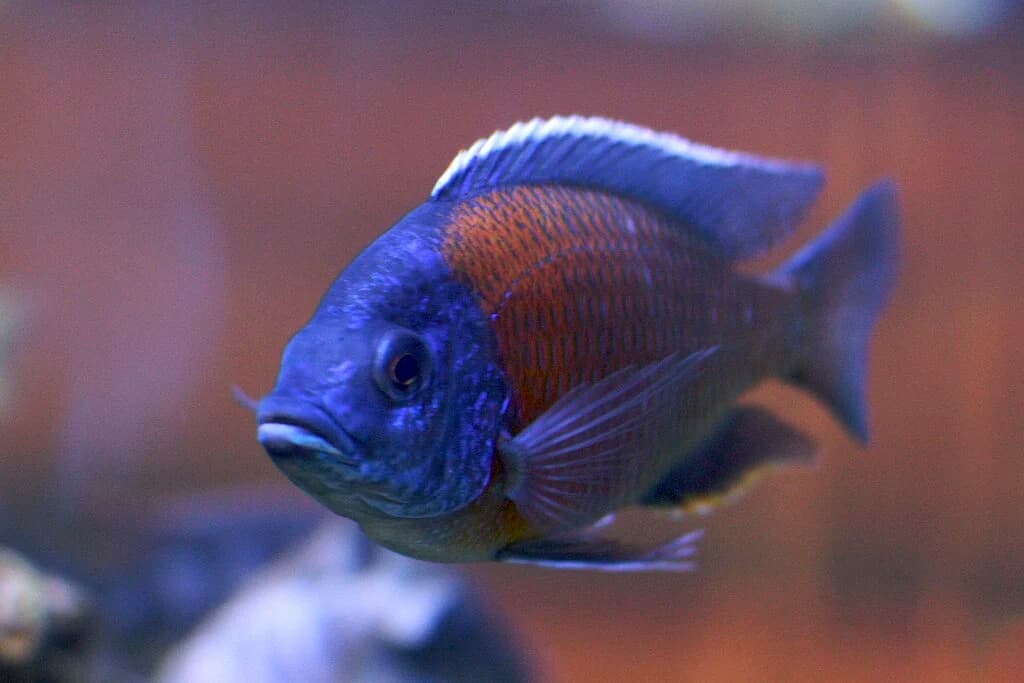
Copadichromis borleyi, commonly known among aquarists as Red Fin Borleyi or Kadango, is one of the most visually striking cichlids from Lake Malawi. This species belongs to the family Cichlidae and inhabits rocky coastal zones in the wild, where it swims in open water near stone reefs.
Sexual dimorphism in Copadichromis borleyi is remarkably pronounced. Adult males develop a stunning coloration: the body takes on a deep metallic blue hue, while the dorsal and caudal fins become fiery red or orange — earning the species its "Red Fin" nickname. Females and juveniles are considerably more subdued, displaying a silvery body with dark vertical bars. Adults reach a size of 12–15 cm, with males typically being larger than females.
The lifespan of Copadichromis borleyi in captivity is 5–10 years with proper care. This is a diurnal species: the fish are actively swimming in the middle and upper water layers, making them an excellent centerpiece for any Malawi aquarium.
Tank Requirements
Keeping Copadichromis borleyi requires a spacious aquarium of at least 300 liters. As a pelagic species accustomed to open water, sufficient horizontal swimming space is of key importance. A tank measuring at least 120 cm in length is an optimal choice.
Water parameters should replicate Lake Malawi conditions:
- Temperature: 24–28 °C
- pH: 7.8–8.6
- Hardness (GH): 10–25
Use rock formations and caves along the sides and back wall of the aquarium, leaving the central area open for swimming. A light-colored sandy substrate will enhance the fish's coloration. Live plants are not essential — they struggle in alkaline water — but Anubias and Vallisneria can be used if desired.
Powerful filtration is a must. A canister filter rated at 5–8 times the tank volume per hour will ensure the necessary water clarity. A gentle current mimics natural conditions and benefits the fish's overall well-being.
Feeding and Diet
In nature, Copadichromis borleyi feeds on zooplankton, small crustaceans, and insect larvae, which it picks from the water column near rocks.
In the aquarium, the staple diet should consist of high-quality pellets or flakes designed for Malawi cichlids with high protein content. Supplement the diet with frozen foods:
- Brine shrimp
- Daphnia
- Cyclops
- Bloodworms (no more than 1–2 times per week)
Practical tip: feed small portions 2–3 times a day rather than one large feeding. This reduces the load on the filtration system and more closely mirrors the fish's natural feeding behavior. To enhance the red pigmentation of the fins, foods containing astaxanthin and spirulina are beneficial.
Avoid overfeeding — Copadichromis borleyi are prone to obesity when kept in relatively sedentary conditions. One fasting day per week is recommended.
Care and Maintenance
Copadichromis borleyi require stable water parameters, which is typical for Malawi cichlids. Weekly water changes of 25–30 % are an essential routine. Use a gravel vacuum to remove uneaten food and waste from the substrate.
Monitor nitrate levels regularly — they should not exceed 20 mg/l. Malawi cichlids are sensitive to elevated nitrogen compounds, and deteriorating water quality quickly affects their coloration and behavior.
Practical tip: during water changes, avoid sudden fluctuations in temperature and pH. Add fresh water slowly, having pre-conditioned it to the appropriate parameters. Using buffer salts to maintain alkalinity is standard practice when keeping Malawi cichlids.
Moderate lighting works well. LED fixtures with cool white or blue spectrum will attractively highlight the metallic sheen of the males.
Compatibility
Copadichromis borleyi is a moderately peaceful cichlid, though males can become territorial, especially during spawning. The optimal setup is one male with 2–3 females. Harem keeping distributes the male's attention and reduces stress on individual females.
The best tankmates are other peaceful to moderately aggressive Lake Malawi cichlids of similar size:
- Aulonocara nyassae — an excellent companion with a calm temperament
- Protomelas taeniolatus — similar requirements and behavior
- Sciaenochromis fryeri — a striking combination with contrasting coloration
- Labidochromis caeruleus — a peaceful mbuna that coexists well with Utaka
Avoid housing with large aggressive mbuna such as Melanochromis and Pseudotropheus — they will dominate and suppress Copadichromis borleyi. Also avoid adding small fish that could be perceived as prey.
With sufficient tank volume and proper tankmate selection, Copadichromis borleyi will display vibrant coloration and natural behavior without exhibiting excessive aggression.
Breeding
Breeding Copadichromis borleyi in the home aquarium is entirely achievable and highly rewarding. They are typical maternal mouthbrooders — the female incubates the fertilized eggs in her buccal cavity.
To stimulate spawning, maintain stable water parameters and provide a nutritious diet. The male selects a flat rock or an area of sandy substrate over which he performs a courtship dance, showcasing his vibrant coloration. A receptive female deposits 20–50 eggs, which she immediately collects into her mouth for incubation.
Incubation lasts 18–25 days at 26 °C. During this period, the female barely feeds, so it is important to ensure she is well-nourished before spawning. Experienced breeders often transfer the brooding female to a separate nursery tank of 40–60 liters to minimize stress.
After release, the fry are already quite large (approximately 8–10 mm) and capable of eating newly hatched brine shrimp or finely crushed food. During the first few days, the female may collect the fry back into her mouth at signs of danger — this is completely normal behavior.
Practical tip: do not attempt to strip the fry from the female prematurely — early extraction leads to high mortality rates and considerable stress for the mother.