Overview
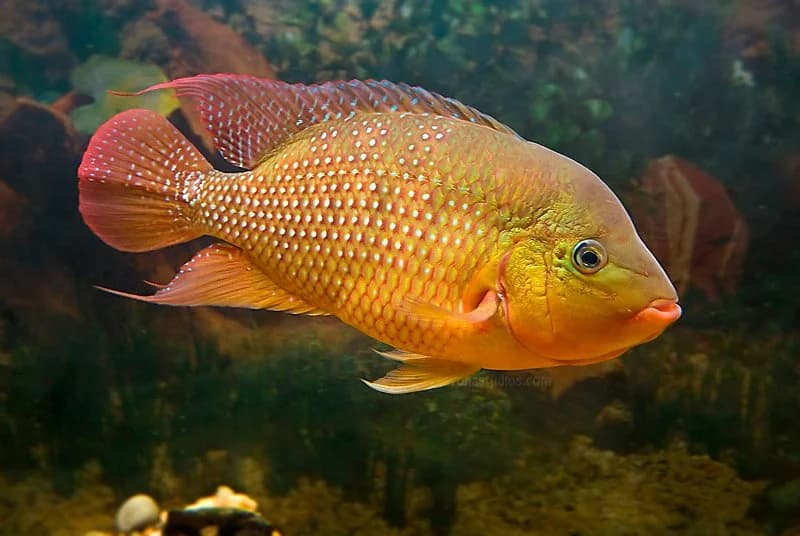
Cichlasoma festae is one of the most impressive large cichlids from South America. In the wild, this species inhabits river systems along the Pacific coast of Ecuador and northern Peru, dwelling in rivers with moderate current and sandy or rocky bottoms. Adults reach 30–35 cm in length, with males generally being larger than females.
The most striking feature of Cichlasoma festae is its coloration. Females are considered among the most beautiful of all freshwater fish: their bodies are covered in rich red-orange hues with contrasting black vertical bars. Males are more subdued in color, displaying greenish-olive and silver tones with a bluish sheen. Sexual dimorphism is visible even in juveniles, which simplifies pair formation.
The species earned its "Red Terror" nickname for good reason: these fish possess pronounced territorial aggression that intensifies with age and especially during spawning. Keeping Cichlasoma festae requires a certain level of experience and a well-thought-out approach to aquarium setup.
Tank Requirements
Cichlasoma festae requires an aquarium of at least 300 liters for a pair. If you plan a community tank with other large cichlids, the volume should be increased to 500–600 liters or more. The tank should be long — at least 150 cm along the longest side — so the fish can establish and demarcate their territories.
Optimal water parameters:
- Temperature: 24–28°C
- pH: 6.5–7.5
- Hardness (GH): 6–15 dGH
Use coarse substrate — gravel or coarse sand — as Cichlasoma festae actively digs and will rearrange fine substrate. Decorations should be heavy and stable: large rocks and massive driftwood. Plants rarely survive in a tank with these fish — only hardy species like Anubias attached to rocks may stand a chance. Be sure to create several hiding spots and visual barriers, as this helps reduce aggression levels.
Filtration must be powerful: an external canister filter rated at no less than 5–6 times the tank volume per hour. These fish produce a significant amount of waste, so filtration quality directly impacts their health. Aeration is also essential.
Feeding and Diet
In the wild, Cichlasoma festae is a predator with omnivorous tendencies. Its natural diet consists of small fish, crustaceans, aquatic insects and their larvae, along with some plant matter.
A recommended aquarium diet:
- Staple (60–70%): high-quality pellets for large cichlids with high protein content
- Live and frozen foods (20–30%): bloodworms, shrimp, mussels, earthworms, fish fillet
- Vegetable supplement (10%): blanched spinach, zucchini, peas, spirulina
Feed adult fish once a day, with one fasting day per week. Juveniles should be fed twice daily. It is important not to overfeed — Cichlasoma festae are prone to obesity, which negatively affects their health and breeding ability. Avoid regularly feeding mammalian meat (beef heart and similar), as this can lead to digestive problems.
Care and Maintenance
Caring for Cichlasoma festae is not particularly difficult as long as basic rules are followed. Weekly water changes of 25–30% are mandatory. Given the high biological load these large fish produce, regularly testing water parameters is a necessity, not a luxury.
Monitor ammonia and nitrite levels — both should remain at zero. Keep nitrates below 30 mg/l. When nitrate levels rise, the fish become lethargic and more susceptible to disease. Clean the filter at least once a month, rinsing media in removed tank water.
Cichlasoma festae are hardy fish with strong immune systems, but in poor conditions they can develop hole-in-the-head disease (hexamitiasis), which is common among many large cichlids. Prevention is straightforward: clean water, a varied diet, and minimal stress.
Pay attention to equipment placement: these fish are very strong and capable of moving rocks and damaging equipment. Heaters and thermometers should be protected with guards, and decorations must be securely anchored.
Compatibility
Cichlasoma festae is one of the most aggressive species in the aquarium hobby. The ideal setup is a species-only tank with a single pair. If you still wish to create a community tank, choose tankmates with extreme care.
Potentially compatible species:
- Oscar — large enough to hold its own, though confrontations are possible
- Jaguar Cichlid — similar in temperament, but requires even more tank volume
- Nicaragua Cichlid — a relatively robust cichlid capable of coexisting given sufficient space
Small and peaceful fish are categorically unsuitable — they will be treated as food. It is also unwise to house them with severums and other relatively calm medium-sized cichlids, as they will not be able to withstand the aggression of the Red Terror.
Aggression escalates significantly during spawning: a bonded pair can terrorize every other inhabitant in the tank, even to the point of killing them. During this time, it is best to remove other fish or plan ahead with reliable tank dividers.
Breeding
Breeding Cichlasoma festae in an aquarium is quite achievable. The difficulty lies not so much in the spawning process itself but in forming a compatible pair. Males can kill females that are not ready to spawn, so it is best to raise a group of juveniles together and allow them to choose their own partners.
For spawning, the pair selects a flat surface — a large rock, ceramic pot, or the wall of a cave. The female deposits 300 to 1,000 eggs, which both parents actively guard. Incubation lasts 3–4 days at 26–27°C, after which the larvae spend another 4–5 days absorbing their yolk sacs.
Parental behavior in Cichlasoma festae is exceptionally strong. Both parents care for the offspring: they fan the eggs with their fins, remove unfertilized ones, and later escort the school of fry around the tank. This period is one of the most fascinating to observe but also the most dangerous time for any tankmates.
First foods for the fry include brine shrimp nauplii and microworms, followed by finely ground pellets. Fry grow quickly, reaching 4–5 cm by 3–4 months of age. As they grow, juveniles begin showing aggression toward one another, so it is important to separate them in a timely manner.