Overview
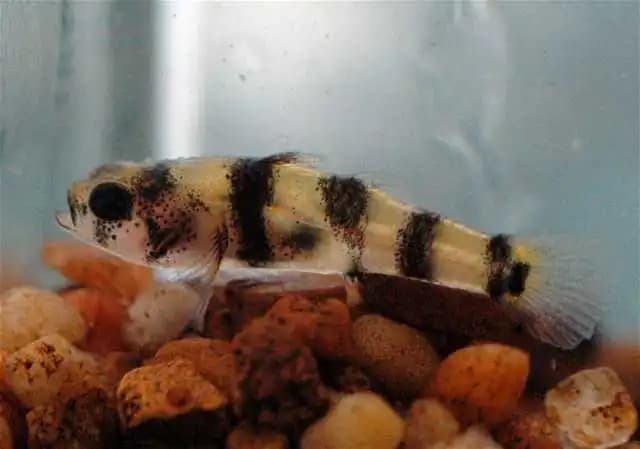
Brachygobius xanthomelas is a miniature bottom-dwelling fish from the Gobiidae family, commonly known as the Bumblebee Goby due to its distinctive black and yellow striped pattern. This species originates from Southeast Asia, inhabiting coastal brackish waters in Thailand, Malaysia, and Indonesia — mangrove areas, river estuaries, and slow-moving flooded lowlands.
Adults reach only 2.5–3.5 cm in length, making them one of the smallest aquarium fish available. The body is elongated and slightly compressed laterally, with a large head and fused pelvic fins characteristic of gobies, forming a suction disc that allows the fish to firmly attach to rocks and decorations. With proper care, they live 2–3 years in aquariums.
It is important not to confuse this species with the closely related Brachygobius doriae, which is also sold under the common name "Bumblebee Goby." B. xanthomelas features more contrasting band patterns and somewhat different water parameter preferences.
Tank Requirements
A group of 5–6 Brachygobius xanthomelas requires an aquarium of at least 60 liters. Despite their small size, they need sufficient space to establish individual territories.
Optimal water parameters: temperature 24–28 °C, pH 7.0–8.5, general hardness (GH) 8–20 dGH. This species prefers slightly brackish water — adding marine salt at 2–5 grams per liter significantly improves their well-being and reduces the risk of fungal infections. The specific gravity should be approximately 1.002–1.008.
Fine sand or smooth gravel works best as substrate. The aquarium should be generously decorated with rocks, ceramic tubes, coconut shells, and driftwood to create numerous hiding spots and caves. Each goby seeks its own shelter, so the number of hiding spots should exceed the number of fish. Live plants can be used, but choose salt-tolerant species — Java moss, Anubias, and Vallisneria.
Water flow should be gentle to moderate, as these fish inhabit calm waters in the wild.
Feeding and Diet
Brachygobius xanthomelas is a typical micro-predator. In nature, it feeds on small crustaceans, insect larvae, and zooplankton. In the aquarium, the diet should consist primarily of live and frozen foods: baby brine shrimp, daphnia, cyclops, small bloodworms, and tubifex.
These gobies accept dry foods very reluctantly, and some individuals refuse them entirely. Therefore, it is worth securing a reliable source of live food before purchasing these fish. Hatching your own brine shrimp is an excellent solution — it is straightforward and provides fresh, nutritious food year-round.
Feed 2–3 times daily in small portions. Gobies are slow eaters that collect food primarily from the bottom, so it is important to ensure food sinks to the substrate and is not intercepted by faster-swimming tank mates.
Care and Maintenance
Keeping Brachygobius xanthomelas is not particularly difficult provided water parameters remain stable. Weekly water changes of 20–25 % are essential — fresh water must be salted to the same level as the aquarium water. Use aquarium-grade marine salt, never table salt.
Filtration should be effective but not create strong currents. An air-driven sponge filter is an excellent choice for a goby tank: it provides biological filtration and gentle water flow, and fry are not at risk of being drawn inside.
Regularly monitor ammonia, nitrite, and nitrate levels using test kits. These gobies are sensitive to elevated nitrogen compounds. Also keep an eye on salinity — evaporation gradually increases salt concentration, so top off only with fresh water to compensate.
These fish are primarily diurnal, most active during morning and evening hours. Lighting can be moderate — excessively bright light causes them to hide.
Compatibility
Brachygobius xanthomelas is a peaceful fish with an aggression rating of 1 out of 5, though males may show territoriality toward each other. These gobies are best kept in a group of 5–6 individuals in a species-only tank — this helps them feel more confident and display more natural behavior.
In a community tank, choose tank mates from small, peaceful brackish water species. Suitable companions include small rainbowfish, certain livebearers (mollies, mosquitofish), and other small gobies, including Brachygobius doriae.
Large and aggressive fish are completely unsuitable, as are active fast-swimming species (barbs, danios) that will outcompete the slow-moving gobies for food. Amano shrimp and Neocaridina may become prey, so keeping them with small shrimp is not recommended.
Breeding
Breeding Brachygobius xanthomelas in the aquarium is of moderate difficulty. For spawning, it is best to move a pair or a group of 2 males and 3–4 females to a separate breeding tank of 20–30 liters. Males are typically larger and more brightly colored, while females become noticeably plumper when ready to spawn.
Water parameters in the breeding tank: temperature 26–28 °C, pH 7.5–8.0, salinity slightly lower than in the main aquarium. Narrow ceramic tubes, inverted flower pots, or halved coconut shells serve as ideal spawning substrates. The male selects a shelter, cleans it, and actively courts the female by displaying vivid breeding coloration.
The female deposits 50–200 small eggs on the ceiling of the shelter, after which the male fertilizes them and takes over guarding duties. At this point, the female should be removed. The male fans the eggs with his fins and defends the clutch from any intruders.
Incubation lasts 7–10 days depending on temperature. Newly hatched larvae feed on their yolk sac for the first few days, then should be offered infusoria, microworms, or baby brine shrimp. Fry grow slowly and require clean water with regular changes.