Overview
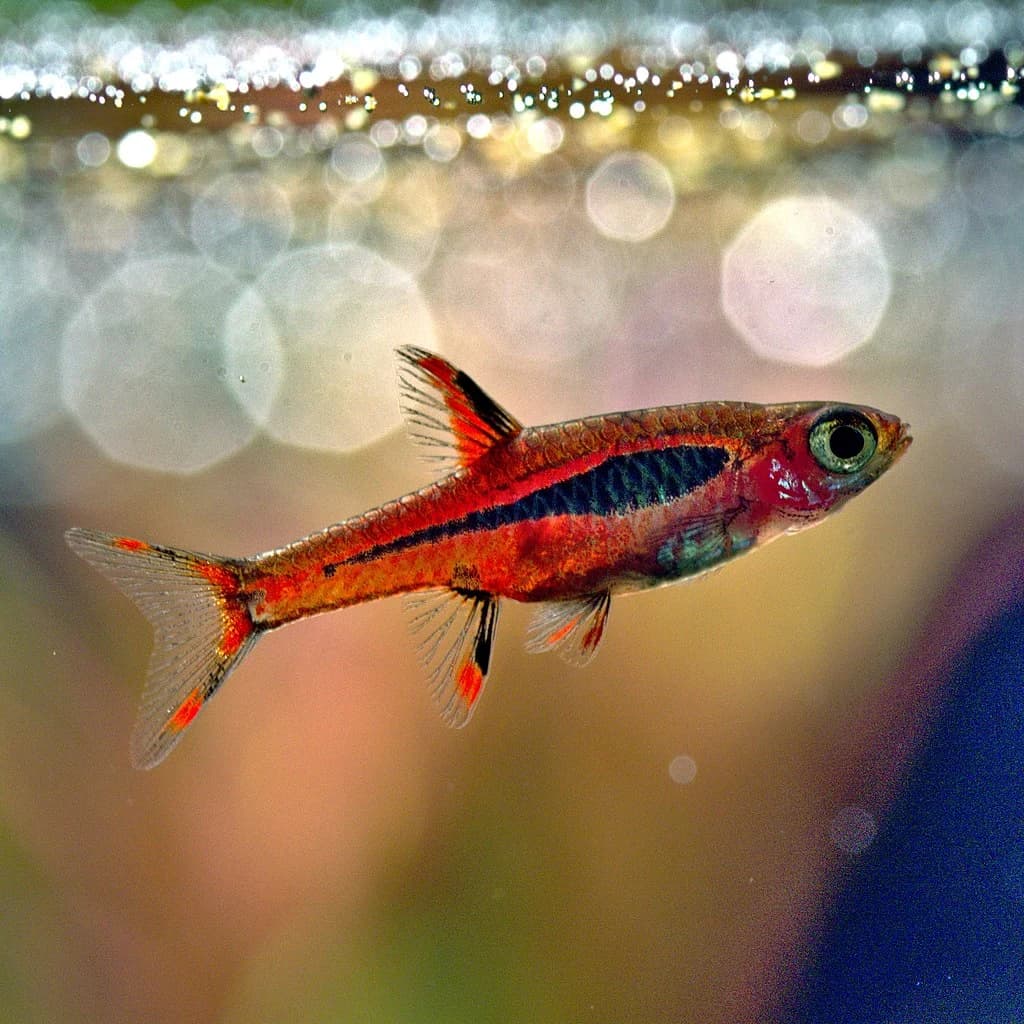
Boraras brigittae is one of the smallest aquarium fish in the world and a true gem of nano fishkeeping. This tiny member of the family Cyprinidae inhabits peat swamps and waterlogged streams of southern Borneo (Kalimantan), where it lives in soft, acidic water stained dark brown by tannins.
The fish grows to just 2–3 cm and lives 2–4 years with proper care. Despite its miniature size, Boraras brigittae boasts one of the most vivid colorations among freshwater fish — the body is a rich red-orange with a dark longitudinal stripe along the lateral line, bordered by a bright red margin. Males are more intensely colored than females and develop an especially deep ruby hue during courtship. Females are slightly larger and paler, with a more rounded belly.
The behavior rating is 1 out of 5 — this is an entirely peaceful fish that shows no aggression even in tight quarters. In a school, males engage in bloodless "tournaments," displaying spread fins and brilliant coloration to one another — a spectacle that draws many aquarists to this species.
Tank Requirements
A school of Chili Rasboras can be kept in an aquarium as small as 30 liters — this is one of the few species genuinely suited for nano tanks. Optimal water parameters are: temperature 22–28 °C, pH 6.0–7.5, and general hardness GH 4–8. For the most vibrant coloration, soft, slightly acidic water is recommended — pH 6.0–6.5 and GH 4–6.
The ideal setup is a Borneo peat swamp biotope: dark substrate, abundant fine-leaved plants, driftwood, and fallen Indian almond or oak leaves that tint the water an amber hue. It is against a dark background that the red coloration of Boraras brigittae truly shines. Java moss, Bucephalandra, Cryptocoryne, and floating plants (Pistia, Riccia) create the perfect environment. Floating plants are especially important — they diffuse light and provide a sense of security.
Water flow should be minimal — in the wild, these fish inhabit virtually still water. A powerful filter with strong current will exhaust them. A sponge filter is the optimal choice: it provides biological filtration without creating dangerous currents for such tiny fish.
Feeding and Diet
Boraras brigittae is a micro-predator that in the wild feeds on tiny invertebrates, insect larvae, zooplankton, and small worms. The main feeding challenge is the fish's miniature mouth size. Standard flakes and pellets are too large for these fish.
The staple diet should consist of finely crushed flakes or micro-pellets specially designed for small fish. However, the true blossoming of coloration comes with regular feeding of live and frozen foods: baby brine shrimp, microworms (grindal worms, nematodes), and cyclops. Moina daphnia is another excellent food of suitable size.
Feed 1–2 times daily in very small portions. Chili Rasboras eat at a leisurely pace, carefully selecting each particle. Ensure food does not settle to the bottom — these fish feed primarily in the mid-water column. Overfeeding is particularly dangerous for such small fish — uneaten food quickly degrades water quality in small tanks.
Care and Maintenance
The care level for Boraras brigittae is rated 2 out of 5. The fish is undemanding but requires stable water parameters and attentive maintenance of the nano aquarium.
Weekly water changes of 15–20% are mandatory. In small tanks, parameters shift faster than in larger ones, making consistent water changes critically important. Filtration should be a sponge filter or a low-power internal filter with adjustable flow. Ammonia and nitrites must be strictly at zero, nitrates below 20 mg/l.
Keep Chili Rasboras in a school of at least 10 individuals, ideally 15–20. In small groups they fade in color, hide, and fail to display natural behavior. It is in a large school that males begin competing for female attention, "igniting" to their maximum brightness. This is a schooling fish, and solitary or pair keeping is a serious mistake.
Note that Boraras brigittae is sensitive to sudden parameter swings. Add new water slowly during changes, warming it to the tank temperature first. When transferring fish, use the drip acclimation method.
Compatibility
Boraras brigittae is an exceptionally peaceful fish with a behavior rating of 1 out of 5, ideal for a species-only nano aquarium. When selecting tankmates, the cardinal rule is: no large fish. Even non-aggressive but sizeable species will frighten the tiny rasboras and suppress them.
The best companions are other micro fish: Dwarf Rasboras, Phoenix Rasboras, Harlequin Rasboras, and Celestial Pearl Danios. They coexist excellently with dwarf corydoras — Pygmy Corydoras makes an ideal bottom-dwelling companion.
Neocaridina shrimp (cherry shrimp, Amano shrimp) are wonderful tankmates that Chili Rasboras will not bother. Dwarf Puffers are a debatable option: they also prefer soft water but may show curiosity toward tiny neighbors.
Completely unsuitable are: any fish larger than 5–6 cm, active and fast-moving species (Tiger Barbs, Zebra Danios), and any large cichlids or predators. Even Bettas are inadvisable — they may perceive the bright red rasboras as rivals.
Breeding
Breeding Boraras brigittae is rated 3 out of 5 in difficulty. In a well-planted species-only tank, spontaneous spawning occurs regularly, but fry survival in a community setup is minimal.
For intentional breeding, prepare a small spawning tank (5–10 liters) with soft, acidic water: temperature 26–28 °C, pH 5.5–6.5, GH 2–4. Line the bottom with Java moss or other fine-leaved plants to serve as a spawning substrate. Lighting should be minimal, and filtration limited to an air-driven sponge filter.
Transfer a pair or small group (2 males and 3–4 females) to the breeding tank. Spawning occurs in the morning hours — the female scatters tiny, transparent eggs (typically 5–15 at a time) among the plants. The eggs are non-adhesive and either fall to the bottom or lodge in the moss.
Remove the adults immediately after spawning — there is no parental instinct, and the breeders will readily eat their own eggs. The eggs are light-sensitive — shade the breeding tank. Larvae hatch within 24–48 hours and become free-swimming by day 3–5. First food should be infusoria and rotifers, transitioning to baby brine shrimp after 7–10 days. Fry grow slowly and develop adult coloration by 3–4 months of age.