Overview
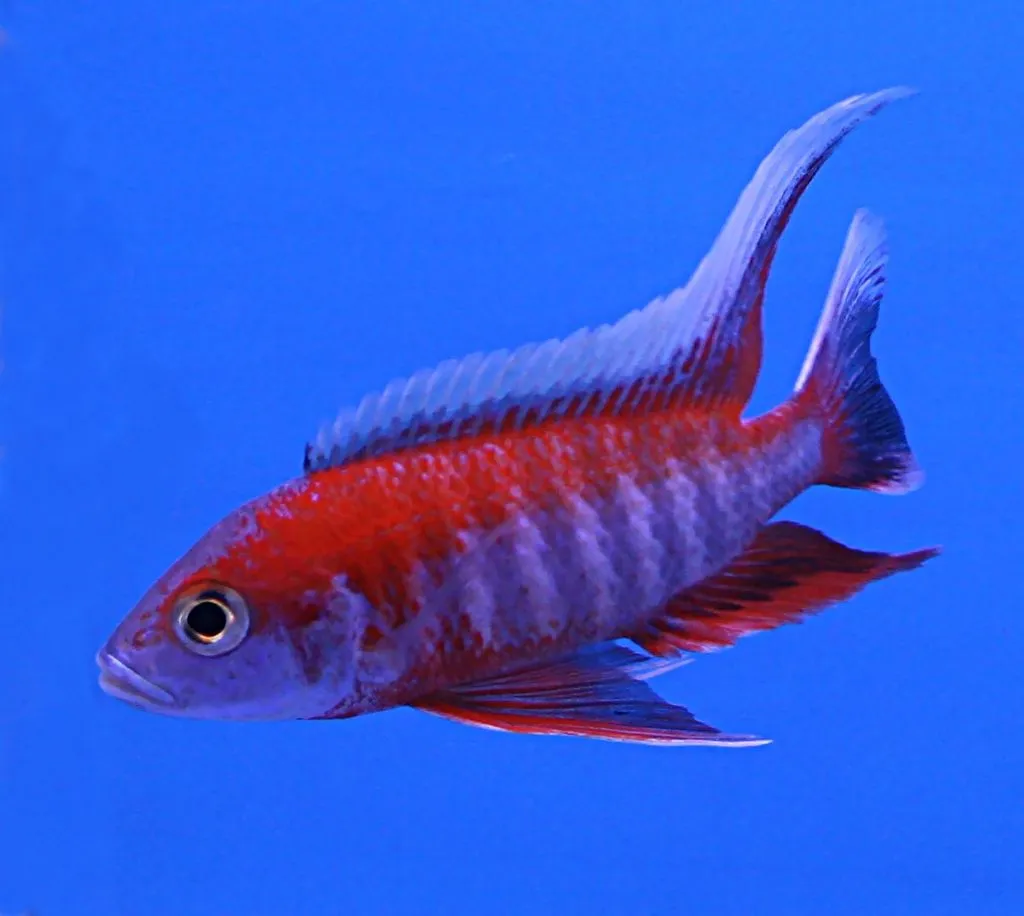
Aulonocara eureka is a selectively bred form of peacock cichlids from Lake Malawi, developed from Aulonocara jacobfreibergi. It is one of the most striking Aulonocara varieties: males display a vivid red or orange-red body contrasting dramatically with a metallic blue head and gill covers. Females, as with all Aulonocara, are plainly colored in grayish-brown tones.
The fish grows to 10–12 cm and lives 5–10 years. Males reach their full coloration at 8–12 months, and the colors only intensify with age. Aulonocara eureka belongs to the group commonly known as "peacocks" — cichlids of the genus Aulonocara, renowned for their extraordinary range of bright colorations.
Like all Aulonocara, the Eureka possesses a unique system of sensory pores on the lower jaw that allows it to detect the slightest movements of invertebrates in sand. In the aquarium, you can observe this characteristic behavior: the fish hovers motionlessly above the substrate, then strikes with a sudden lunge to capture prey.
Tank Requirements
Keeping a group of Aulonocara eureka requires an aquarium of at least 200 liters. Optimal water parameters are typical for Malawi cichlids: temperature 24–28 °C, pH 7.5–8.5, and general hardness GH 10–20. These parameters replicate the alkaline environment of Lake Malawi.
The substrate must be sand. Aulonocara hunt by sifting sand through their gills, and coarse substrate can damage their sensitive sensory pores. The layout should feature rock formations with caves and crevices that create territories and shelters. Place rocks along the sides and back wall, leaving an open sandy area in the center.
Live plants are rarely used in Malawi setups due to the alkaline water, though tough-leaved species (Anubias, Vallisneria) can survive. Lighting should be moderate to bright to showcase the fish's coloration.
Feeding and Diet
In the wild, Aulonocara are micro-predators that feed on small invertebrates, insect larvae, and zooplankton extracted from the sandy bottom. In the aquarium, Aulonocara eureka is not fussy about food, but a balanced diet is critically important.
The staple diet should consist of quality cichlid pellets enriched with carotenoids to enhance coloration. Regularly supplement with frozen foods: brine shrimp, bloodworms, cyclops, and mysis shrimp. Live foods are an excellent treat but should be offered cautiously due to the risk of introducing infections.
Feed twice daily in small portions. Strictly avoid overfeeding — Malawi cichlids are prone to abdominal bloating (Malawi bloat), which is often linked to improper nutrition. Do not offer foods high in mammalian fats and proteins (beef heart, large amounts of tubifex).
Care and Maintenance
Aulonocara eureka is a moderately demanding cichlid (care level 3 out of 5), suitable for aquarists with some cichlid-keeping experience. Stable water parameters are the key to health and vibrant coloration.
Weekly water changes of 25–30% are essential. Filtration should be powerful — an external canister filter is preferred. Monitor nitrate levels: they should not exceed 20 mg/l, as Malawi cichlids are particularly sensitive to elevated nitrates.
The main health risk is Malawi bloat, which manifests as abdominal swelling, loss of appetite, and lethargy. Prevention includes quality varied nutrition, clean water, and the absence of chronic stress from aggressive tankmates.
Compatibility
Aulonocara eureka is one of the more peaceful Malawi cichlids (behavior rated 3 out of 5), but males become territorial, especially during spawning. It is best to keep one male with 2–3 females.
Excellent tankmates include other Aulonocara: Aulonocara jacobfreibergi, Aulonocara nyassae, as well as peaceful Malawi species such as Labidochromis, Copadichromis, and Protomelas. Cohabitation with Iodotropheus is also acceptable.
Do not keep with aggressive mbuna: Pseudotropheus and Maylandia will harass and stress the calmer Aulonocara. Also avoid housing males of different Aulonocara species with similar coloration — this provokes heightened aggression. Small fish (tetras, rasboras) will become prey.
Breeding
Breeding Aulonocara eureka is not particularly difficult (rated 3 out of 5) and is achievable in a home aquarium. Like all Aulonocara, they are maternal mouthbrooders: the female carries the fertilized eggs in her mouth for 18–21 days.
For spawning, the male claims a territory — usually a flat rock or a cleared patch of sand — and displays his vibrant colors to attract a female. After the eggs are laid, the female collects them in her mouth, and fertilization occurs via the "egg spot" method — false egg markings on the male's anal fin.
The brooding female refuses food for the entire incubation period and loses noticeable weight. In a community tank, fry should not be released — they will be eaten by tankmates. It is recommended to carefully move the female to a separate 30–40 liter tank a few days before the fry are released. From the first day, fry accept baby brine shrimp and finely crushed pellets. A typical clutch contains 15–30 fry.