Overview
Arnoldichthys spilopterus is a striking member of the Alestidae family, native to tropical rivers and streams of Nigeria, particularly around the Lagos area and the Niger Delta. It is one of the largest and most impressive tetras available to aquarists, and a close relative of the famous Congo Tetra.
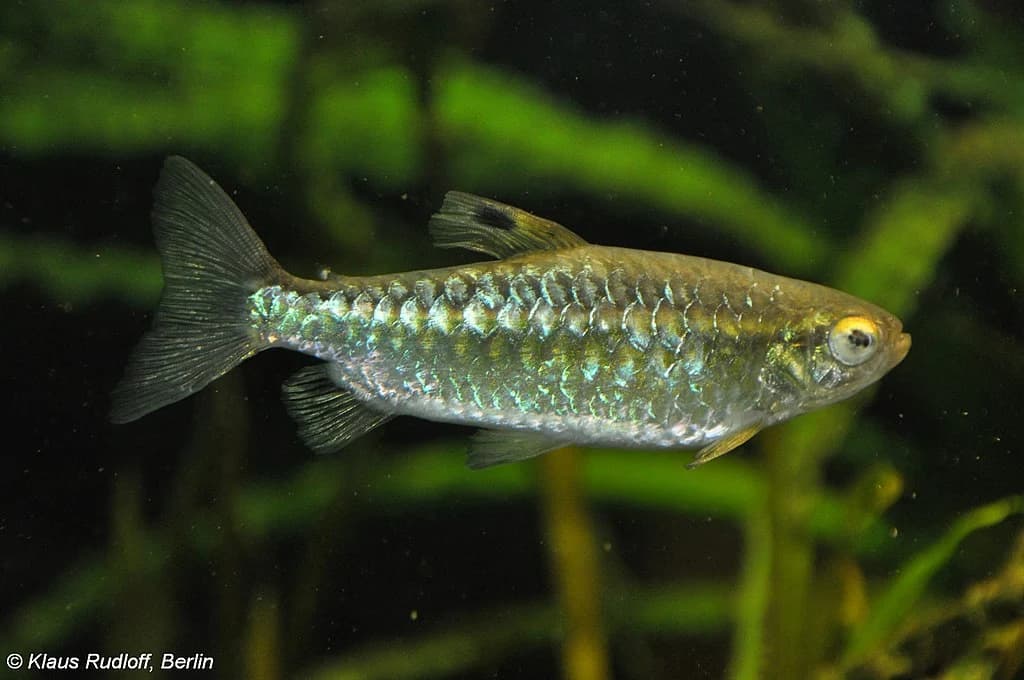
The fish grows to 8–10 cm and immediately catches the eye with its large red-orange eyes, which gave it its popular name. The body is silver with a greenish-blue sheen, and each scale shimmers as the fish moves. Males are more colorful than females and possess a particularly impressive anal fin with bands of red, yellow, and black. Females are more subdued — their anal fin is plain. Lifespan in the aquarium is 5–7 years.
Arnoldichthys spilopterus is an active schooling fish that spends most of its time in the middle and upper water layers. In a group, these tetras display captivating synchronized swimming and generally behave confidently and calmly.
Tank Requirements
Keeping a school of Arnoldichthys spilopterus requires an aquarium of at least 120 liters. These are large, active fish that need ample swimming space. Optimal water parameters are: temperature 22–28 °C, pH 6.0–7.5, and general hardness GH 5–12.
The aquarium must have a tight-fitting lid — Arnold's Tetras are prone to jumping, especially when startled or during the acclimation period. This is a crucial point that should not be overlooked.
The setup is best designed as a West African river biotope: dark substrate, driftwood, areas of dense vegetation along the sides, and a spacious open swimming zone in the center. Floating plants will help soften the light and give the fish more confidence. Water flow should be moderate, mimicking natural conditions. In subdued lighting, the scales of Arnold's Tetras shimmer especially beautifully.
Feeding and Diet
In the wild, Arnoldichthys spilopterus is an omnivore that feeds on insects that fall on the water surface, small invertebrates, and plant matter. In the aquarium, these fish are undemanding and readily accept most foods.
The staple diet can consist of quality flakes or granules for tropical fish. To maintain vibrant coloration and good health, regularly supplement with live or frozen foods: bloodworms, brine shrimp, daphnia, and glassworms. Arnold's Tetras feed primarily from the surface and mid-water — sinking tablets are not suitable for them.
Feed twice daily in small portions consumed within 2–3 minutes. An occasional fasting day once a week benefits digestion.
Care and Maintenance
Arnold's Tetra is a hardy fish with a care level of 2 out of 5, suitable for aquarists with minimal experience. The key requirement is stable water parameters and regular tank maintenance.
Weekly water changes of 25–30% are essential. Filtration should ensure good water quality and moderate flow. Both external and powerful internal filters are suitable. Monitor nitrate levels — they should not exceed 25 mg/l.
Arnold's Tetras must be kept in a school of at least 6–8 individuals — in a small group, the fish become nervous, lose their color, and may act timid. In a larger school, they feel confident and display the full beauty of their behavior.
Compatibility
Arnoldichthys spilopterus is a peaceful schooling fish with a behavior rating of 2 out of 5, making it an excellent choice for community tanks. Thanks to its calm temperament and medium size, it is compatible with a wide range of species.
Excellent tankmates include Congo Tetras, Long-finned Characins, Corydoras, Bristlenose Plecos, Kribensis, and Kuhli Loaches. They also coexist well with other peaceful medium-sized fish — danios, rasboras, and rainbowfish.
Avoid housing them with very small fish (fry and micro species may be eaten) and large aggressive cichlids that would frighten the school. Conflicts with territorial bottom-dwellers are rare, as Arnold's Tetras stay in the upper water layers.
Breeding
Breeding Arnoldichthys spilopterus in the aquarium is possible but requires some preparation — the difficulty is rated 3 out of 5. For spawning, prepare a separate tank of 40–60 liters with soft, slightly acidic water: pH around 6.0–6.5, temperature 26–28 °C, and GH no higher than 5.
Arnold's Tetras are egg scatterers. Line the bottom of the breeding tank with fine-leaved plants or a synthetic mesh to protect the eggs from being eaten. Lighting should be dim. Condition the pair with live foods for 1–2 weeks before spawning.
After spawning, the adults must be removed immediately. The eggs incubate for 24–36 hours, and after 3–4 days the fry become free-swimming. First food should be infusoria and baby brine shrimp. The fry grow relatively slowly and require frequent water changes in the rearing tank to maintain pristine water quality.