Overview
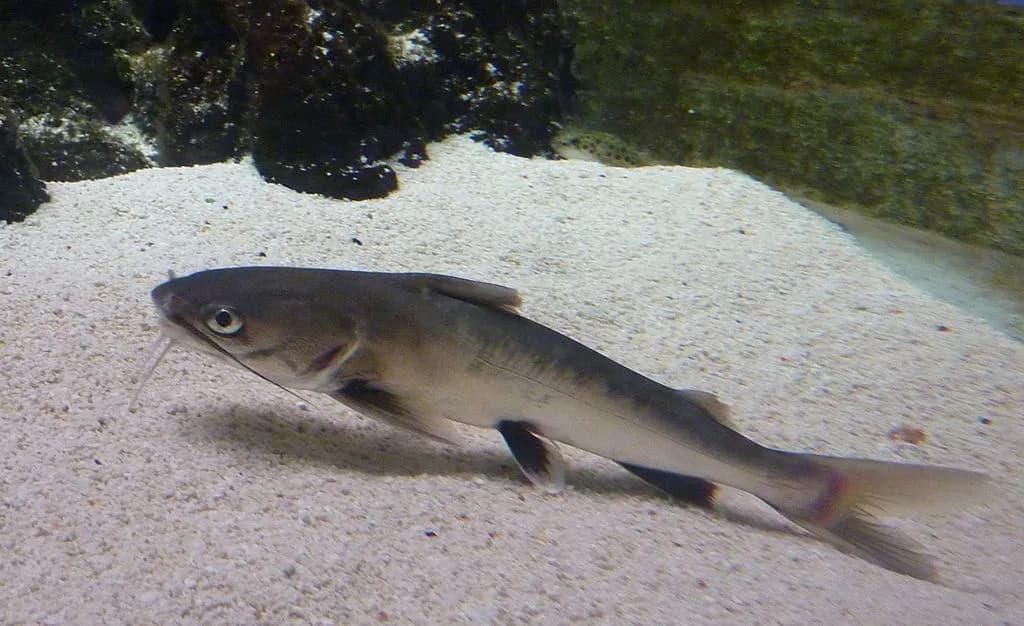
Jordan's Catfish (Arius jordani) is an impressive freshwater-to-brackish catfish from the Ariidae family, also known as the "Colombian Shark" due to its characteristic silhouette resembling a marine shark. In the wild, it inhabits estuaries, mangrove areas, and coastal rivers of Central and South America, where it occurs in both fresh and brackish water.
Adults reach substantial sizes of 30–60 cm, making this one of the larger species in the aquarium hobby. The body is elongated and streamlined, silver in color with distinctive white tips on the fins — hence the name "Silvertip Shark." The caudal fin is deeply forked, and long barbels help the fish navigate murky waters. Lifespan is 8–12 years.
Arius jordani is primarily a nocturnal species. During the day, the fish prefers shelter, becoming more active at dusk and through the night. Despite its peaceful nature, this is a schooling fish best kept in groups of at least 3 — solitary individuals tend to become shy and stress-prone.
How to Distinguish Males from Females?
Sexual dimorphism is subtle. Males are generally somewhat slimmer than females. The most obvious difference appears during spawning: males carry eggs in their mouths, making them easily identifiable during this period.
Tank Requirements
Given the size and activity level of Arius jordani, an aquarium of at least 250 liters is required, with 400 liters or more preferred as the fish grow. The tank should be elongated with ample open swimming space.
Optimal water parameters:
- Temperature: 24–28°C
- pH: 7.0–8.5
- Hardness (dGH): 10–25
- Salinity: addition of marine salt (5–15 g/L) is recommended to create brackish conditions
Use large rocks, driftwood, and ceramic caves for decoration — the fish need shelters for daytime rest. Sandy substrate is preferred, as the catfish sift through it while foraging. Only salt-tolerant live plants are suitable (Java moss, Anubias). Powerful filtration and strong aeration are essential — these fish are sensitive to water quality and require high oxygen levels. A tight-fitting lid is mandatory — Arius jordani can jump.
Feeding and Diet
Arius jordani is an omnivorous predator with a strong preference for protein-rich foods. The aquarium diet should include:
- Large sinking pellets for predatory catfish (staple diet)
- Frozen foods: shrimp, mussels, fish fillet pieces, bloodworms
- Live foods: small fish, earthworms, large brine shrimp
- Vegetable supplements: blanched zucchini, spinach, spirulina tablets
Feed once daily, preferably in the evening when the fish are most active. Juveniles should be fed twice daily. Avoid overfeeding — at their large size, these catfish produce considerable waste, which rapidly degrades water quality.
Care and Maintenance
Keeping Arius jordani requires moderate experience and a diligent approach to tank maintenance:
- Water changes: 25–30% weekly, with careful salinity matching of replacement water
- Filtration: a powerful external filter rated for 1.5–2 times the actual tank volume
- Aeration: essential, preferably using an air pump with diffusers
- Salinity monitoring: use a hydrometer or refractometer for accurate measurements
Regularly test water parameters — ammonia, nitrites, and nitrates. Large catfish produce substantial waste, so biological filtration must be mature and efficient. Vacuum the substrate during each water change, paying special attention to areas around shelters.
Compatibility
Arius jordani is a peaceful but large species that may accidentally swallow small tank mates. Suitable companions include:
- Monodactylus — a classic companion for brackish aquariums
- Scatophagus — another hardy brackish-water inhabitant
- Archerfish — an active companion for the upper water layers
- Other large brackish-water species
Avoid keeping them with small fish (under 8–10 cm) that may be seen as prey. Also avoid aggressive territorial species that could damage the catfish's long barbels. Bumblebee gobies and other small bottom dwellers are unsuitable tank mates.
Within their school, Arius jordani establish a mild hierarchy, but serious conflicts rarely occur when adequate space is provided.
Breeding
Breeding Arius jordani in home aquariums is extremely challenging, with successful cases being rare. The key feature of this species is mouthbrooding: after fertilization, the male takes the eggs into his mouth and incubates them for several weeks, completely refusing food during this period.
For a breeding attempt, the following is needed:
- A spacious aquarium of at least 500 liters with shelters
- Stable water parameters with correct salinity
- A group of 5–6 adults for natural pair formation
- Intensified live food feeding for several weeks beforehand
Fry emerging from the male's mouth are already relatively large and can feed on baby brine shrimp and fine frozen foods. However, achieving spawning in aquarium conditions is extremely rare, and most specimens available in the trade are wild-caught.