Overview
Apteronotus albifrons, known as the Black Ghost Knifefish, is one of the most unusual freshwater fish available to aquarists. This species belongs to the family Apteronotidae and inhabits the Amazon Basin as well as rivers in Venezuela, Paraguay, and Peru, where it favors shaded areas with slow currents and dense vegetation.
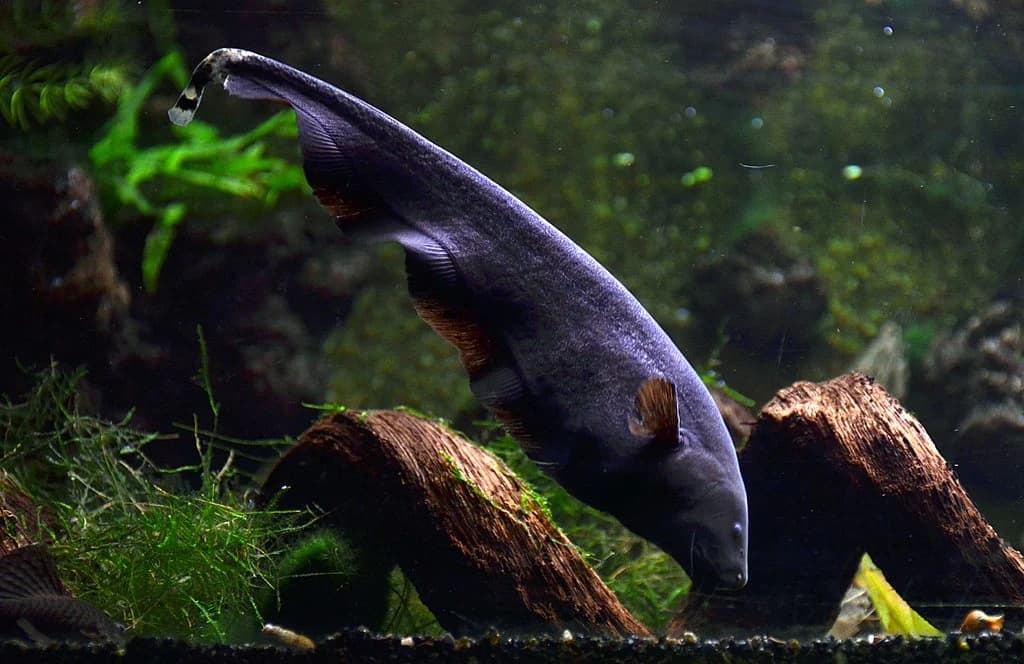
The body of the Black Ghost Knifefish is laterally compressed and completely scaleless, making it particularly sensitive to chemicals and water quality. The coloration is velvety black with two white markings: one on the caudal peduncle and one on the forehead, which gives the species its name albifrons (white-fronted). In aquariums, the fish grows to 20–50 cm, and its lifespan is 10–15 years, making it a truly long-term companion.
The defining feature of the Black Ghost Knifefish is the weak electric field it generates for navigation in murky water and locating food. Thanks to electroreception, the fish "sees" its surroundings perfectly even in complete darkness and can find prey hidden in the substrate.
Tank Requirements
Keeping Apteronotus albifrons requires an aquarium of at least 350 liters — this is a large, active fish that needs space. Optimal water parameters are: temperature 23–28 °C, pH 6.5–7.5, and general hardness GH 5–15.
The aquarium setup should include plenty of hiding spots: driftwood, ceramic tubes, rock caves, and dense plant thickets. The Black Ghost Knifefish is nocturnal and hides in shelters during the day, so without them the fish will experience constant stress. Many aquarists use transparent tubes — this allows observing the fish during the day without disturbing it.
The substrate should be fine and soft — sand or small rounded gravel. The skin of the Black Ghost Knifefish is scaleless, and coarse substrate can damage it. Lighting should be subdued: floating plants will help create diffused light. Water flow should be gentle to moderate.
Feeding and Diet
Apteronotus albifrons is a predator that feeds on aquatic insects, larvae, worms, and small fish in the wild. In the aquarium, the core diet should consist of live and frozen foods: bloodworms, tubifex, glassworms, brine shrimp, as well as small pieces of shrimp and fish fillet.
Some individuals gradually adapt to quality sinking pellets, but the transition to dry food should be slow, and it should not be the sole food source. Flakes are unsuitable — the Black Ghost Knifefish feeds primarily near the bottom and in the middle water layers.
It is best to feed in the evening, after the main lights are turned off, when the fish emerges from its shelter and becomes active. Young fish should be fed daily, adults every other day, in portions consumed within 5–10 minutes.
Care and Maintenance
The Black Ghost Knifefish is a demanding species not recommended for beginner aquarists. The lack of scales makes it especially sensitive to ammonia and nitrite levels, as well as copper-based and formalin medications. Weekly water changes of 25–30% are essential.
Filtration should be powerful and efficient but without creating strong currents. An external canister filter is the best choice for a tank with this species. Regular water testing is mandatory: ammonia and nitrites must remain at zero, and nitrates should stay below 20 mg/l.
It is important to remember that the Black Ghost Knifefish generates a weak electric field. Keeping two individuals in the same aquarium is not advisable — their electric fields will interfere with each other, causing chronic stress and aggression.
Compatibility
Apteronotus albifrons is generally calm toward tankmates but has a moderate temperament and may display territoriality, especially toward bottom-dwelling fish and other knifefish species. It coexists best with medium to large peaceful fish that inhabit the middle and upper water layers.
Good tankmates include Angelfish, Severums, Pearl Gouramis, Congo Tetras, and larger Corydoras. Small fish — neons, guppies, and small rasboras — will be viewed as food, especially at night.
Housing with other knifefish and aggressive cichlids such as Oscars is strongly discouraged, as they can injure the scaleless Black Ghost Knifefish.
Breeding
Breeding Apteronotus albifrons in aquariums is extremely difficult and rarely accomplished in practice. The breeding difficulty is rated at the maximum — 5 out of 5. In commercial facilities, spawning is induced using hormonal injections and by simulating the rainy season: lowering the temperature followed by raising it, accompanied by massive soft water changes.
Determining the sex visually is nearly impossible — males and females are almost indistinguishable externally. Sexual maturity is reached at 1.5–2 years of age when the fish is approximately 15–20 cm long. A breeding pair requires a separate, darkened tank of at least 400 liters with numerous hiding places.
In a home setting, it is best to focus on providing comfortable keeping conditions and leave breeding to specialized facilities. Most Black Ghost Knifefish on the market are wild-caught or bred on farms in Southeast Asia.