Overview
Aplocheilus lineatus, known as the Striped Panchax or Golden Wonder Killifish, is one of the most popular and hardy killifish in the aquarium hobby. This species inhabits still and slow-moving waters of India and Sri Lanka — rice paddies, ditches, small streams, and sheltered backwaters where dense vegetation provides natural cover.
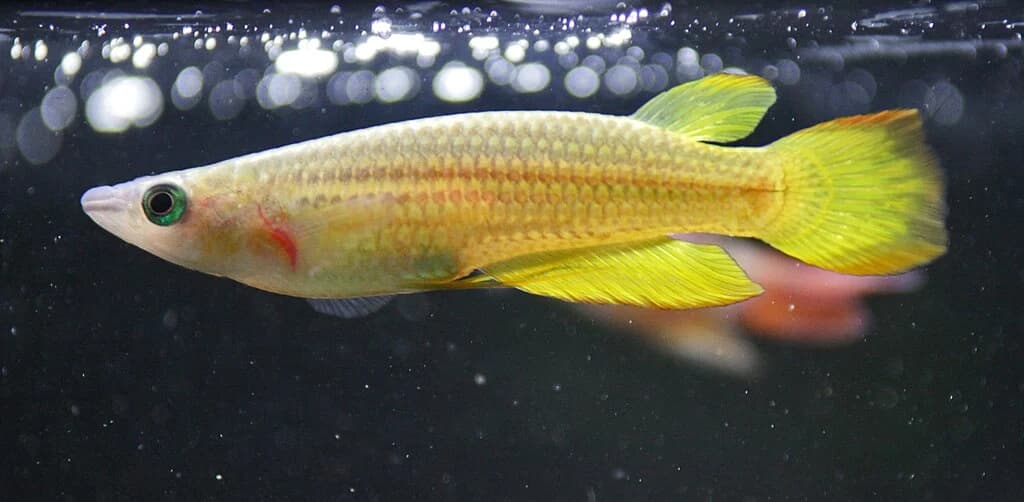
Males grow up to 5–7 cm and display striking coloration: rows of shimmering scales run across a greenish-gold body, while the caudal and anal fins are adorned with red and yellow hues. Females are more subdued in color but feature a distinctive dark spot at the base of the dorsal fin. In aquariums, Striped Panchax typically live 3–5 years.
The Lineatus is a classic surface-dwelling fish. It spends most of its time near the water surface, scanning for fallen insects and small prey. This is an active, curious fish with a strong hunting instinct that is always fascinating to observe.
Tank Requirements
A pair or small group of Aplocheilus lineatus can be kept in an aquarium of at least 60 liters. Optimal water parameters are: temperature 22–28 °C, pH 6.5–8.0, and general hardness GH 5–20.
The aquarium must have a tight-fitting lid — Striped Panchax are excellent jumpers and can easily leap out of an uncovered tank. This is one of the most important rules when keeping this species.
These fish look their best in a tank with floating plants such as Water Lettuce, Salvinia, or Riccia. Floating vegetation creates subdued lighting and mimics their natural habitat. The lower level can be planted with Vallisneria or Cryptocoryne. Water flow should be gentle to moderate, as in the wild these fish inhabit calm waters.
Feeding and Diet
In nature, Aplocheilus lineatus is a predator that feeds on insects, larvae, and small invertebrates from the water surface. In the aquarium, they readily accept a variety of foods but prefer items that float on the surface.
The staple diet can consist of quality flakes or floating pellets. However, to maintain health and vibrant coloration, regularly offer live or frozen foods: bloodworms, daphnia, brine shrimp, and small insects such as fruit flies. It is protein-rich food that truly brings out the beauty of their colors.
Feed twice daily in small portions that the fish consume within 2–3 minutes. Striped Panchax feed primarily from the surface, so sinking pellets are not suitable for them.
Care and Maintenance
The Striped Panchax is a hardy fish that tolerates minor mistakes from beginner aquarists. Nevertheless, stable water quality remains the key to good health. Weekly water changes of 20–25% are recommended.
Filtration should be effective but without creating strong currents. An internal filter or air-driven sponge filter is an ideal choice. Maintain the temperature within the 22–28 °C range and avoid sudden fluctuations.
It is best to keep them as a pair or in a small group of one male with two or three females. Multiple males in a cramped tank may become territorial, so when keeping a group, ensure sufficient space and hiding spots.
Compatibility
Aplocheilus lineatus has a moderate temperament, but its predatory nature should not be forgotten. They coexist well with similarly sized or slightly larger species that inhabit the middle and lower water layers.
Good tankmates include Corydoras, Zebra Danios, Harlequin Rasboras, and other medium-sized fish. Avoid housing them with very small species — tiny fish like Boraras may be seen as prey. Also avoid keeping them with aggressive cichlids that would harass them.
Medium to large shrimp (Amano, filter-feeding species) are generally safe, while small Neocaridina shrimp may become a meal.
Breeding
Breeding Aplocheilus lineatus is not particularly difficult and is accessible even to beginner aquarists. For spawning, prepare a separate tank of 20–30 liters with soft, slightly acidic water at 24–26 °C.
Place fine-leaved floating plants or a synthetic spawning mop in the breeding tank — the female attaches her eggs to their surface. Spawning is usually prolonged: the female lays a few eggs daily over the course of several weeks. It is recommended to collect the eggs and transfer them to a separate container, as the parents may eat them.
Incubation takes 10–14 days at 24 °C. The newly hatched fry are immediately able to accept baby brine shrimp and microworms. The young grow quickly and, with good feeding, develop adult coloration by 3–4 months of age.