Overview
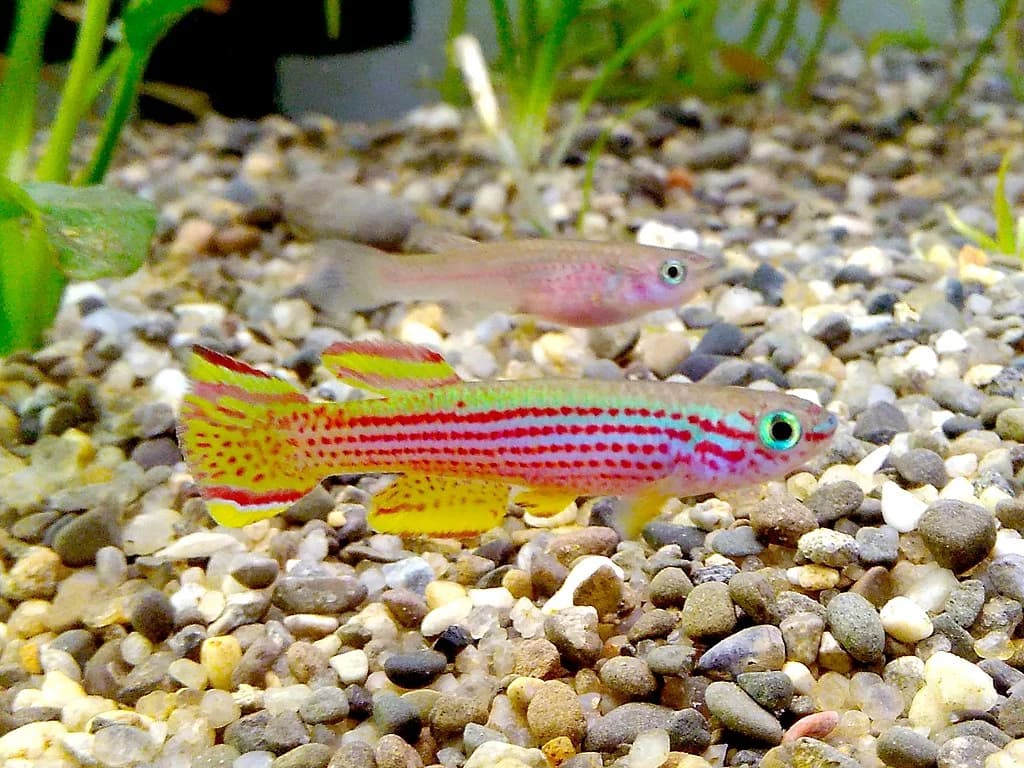
The Red-Striped Killifish (Aphyosemion striatum) is one of the most attractive members of the family Nothobranchiidae. This species originates from small forest streams and swampy pools in Gabon, West Africa, where it inhabits shaded areas with slow current and abundant leaf litter.
Adults reach a size of 4–5 cm, with a lifespan of 2–3 years. Males are stunningly beautiful: their bodies are covered with vivid red horizontal stripes on a golden-green background, and their fins are adorned with red and blue markings. Females are more modestly colored in beige-brown tones with a less pronounced pattern.
Unlike many relatives in its family, Aphyosemion striatum is not a seasonal species — it does not require egg diapause. This makes it one of the best killifish for beginners looking to explore this fascinating group of fish.
Tank Requirements
A pair or small group of Red-Striped Killifish can be kept in an aquarium of at least 30 liters. This species does not need a lot of space but appreciates a well-designed setup.
Optimal water parameters:
- Temperature: 20–24 °C (68–75 °F)
- pH: 6.0–7.0
- Hardness (GH): 1–10 dGH
The aquascape should mimic the natural habitat — a shaded forest stream. Use a dark substrate, dense planting (Java moss, cryptocorynes, ferns), floating plants for subdued lighting, plus driftwood and leaf litter (oak, Indian almond leaves). Leaf litter slightly acidifies the water and gives it a natural yellowish tint, which benefits the fish's well-being.
Filtration should be gentle — an air-driven sponge filter works best. Strong current causes stress in this species. The tank must be covered with a tight-fitting lid, as killifish are excellent jumpers.
Feeding and Diet
In the wild, Aphyosemion striatum feeds on small insects, their larvae, and microscopic invertebrates. In captivity, the fish readily accept a variety of foods but clearly prefer live and frozen items.
Recommended diet:
- Live and frozen foods: small bloodworms, brine shrimp, daphnia, grindal worms, and microworms. These form the dietary foundation and ensure vibrant coloration.
- Dry foods: high-quality micro-pellets or flakes can be used as a supplement but should not be the primary diet.
Feed 1–2 times daily in small portions. Killifish are prone to overeating, so portions should be moderate. Dietary variety is the key to good health and intense coloration.
Care and Maintenance
Aphyosemion striatum is a fairly hardy species, but stable water parameters are critically important. Key guidelines:
- Water changes: replace 15–20% of the volume weekly. Use dechlorinated water matched to the tank temperature.
- Filtration: an air-driven sponge filter is the optimal choice. It provides biological filtration without strong current.
- Temperature control: this species prefers cooler water. Avoid temperatures above 24 °C (75 °F) — elevated heat makes the fish lethargic and shortens their lifespan.
- Parameter monitoring: regularly test for ammonia, nitrites, and nitrates. Killifish are sensitive to the buildup of nitrogenous compounds.
Monitor the condition of leaf litter — replace leaves as they decompose, roughly every 2–3 weeks.
Compatibility
The Red-Striped Killifish is a calm but somewhat territorial fish. Males can display aggression toward each other, so in a smaller tank it is best to keep one male with one or two females.
Suitable tankmates:
- Small peaceful tetras: ember tetras, glowlight tetras
- Small rasboras: chili rasboras
- Dwarf corydoras: pygmy corydoras
- Dwarf shrimp (with caution — killifish may eat shrimplets)
- Other killifish: clown killifish
Avoid large, active, or aggressive fish. Bettas and barbs are poor choices. The Red-Striped Killifish will become stressed in a busy tank with fast-moving fish.
Breeding
Breeding Aphyosemion striatum is not particularly difficult and is accessible even to beginning aquarists.
Preparation:
- Set up a breeding tank of 10–15 liters with a sponge filter and fine-leaved plants (Java moss) or spawning mops.
- Water parameters: temperature 22–23 °C (72–73 °F), pH 6.0–6.5, soft water (GH 2–5).
- For a week before spawning, feed the breeders generously with live food.
Spawning and raising fry:
The male actively courts the female, displaying his spread fins. The female deposits a few eggs daily on fine-leaved plants or spawning mops. Eggs can be collected every few days and transferred to a separate container with water from the breeding tank.
Incubation lasts 10–14 days at 22–23 °C (72–73 °F). After hatching, the fry are relatively large and can immediately accept baby brine shrimp and microworms. Growth is rapid — by 3–4 months the fish begin to show coloration, and by 5–6 months they reach sexual maturity.
Important: adults may eat eggs and fry, so for successful breeding it is best to remove the parents or regularly collect eggs.